|
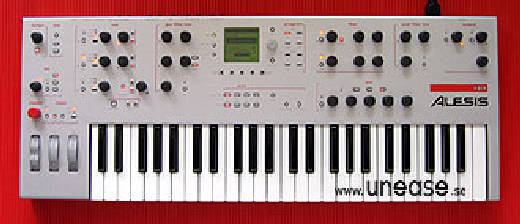
Its main strengths are:
1- Great filters and a great variety of them. You probably heard about that already.
2- Again, you probably heard, the 3 oscilators are great too. You have a lot of control of over your wave shapes, width and pitch. This thing can crank out great bass and is capable of a very full sound.
3- The envelope section is also pretty kick ass. It gives you a control for how long sustain will hold for. It also gives you control of the shape of your attack and decay (2 types of curves and a linear line) which is a nice touch.
4- Great modulation section. You have, I believe, 12 sets of modulation sources and destinations where just about anything can modulate anything.
This thing beats the hell out of the MS2000 which I've owned. The oscilation section is much more intuitive, you have much better control of your wave shapes, and it also pounds out more bottom end. Their is a much greater variety of filters which are much warmer and they can be way dirtier. The ION can modulate the pants off of the MS2000. There's a better distortion section. Then there's the numbers game: The Ion has more parts, better multi-timbral character, etc.
I've owned a few analogs and emulators (Juno 106, Saturn 9, Poly61, Poly800, MS2000r, MFB Synth Lite, BassStation, AN200, CZ5000 and Darkstar2) and this thing does the analog thing, gasp, perfectly. I cannot think of a better analog emulator and it is a much better choice than a 106 that'll crap out in 2 months. It'll give you more veratility than most others especially in the ION's price range.
|