|
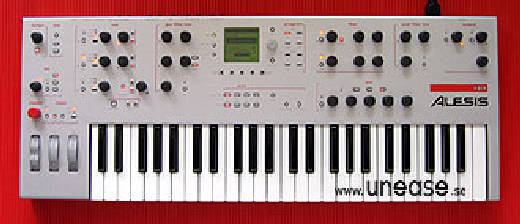
I am using the ION as a synthesizer (not a workstation) so the relative low polyphony does not bother me. Design wise I think it is kind of ugly & beautiful at the same time, like many of the synthesizers from the past. I like that it is quite heavy for it’s size, it gives me a sturdy and professional impression. The user interface is not hard to come around if you have used an analogue synth before. Still Alesis ION is a quite complex synthesizer, crammed with an array of functions never found on any single analogue synthesizer 30 years ago. Although not every parameter is directly accessible from the front panel, the most common parameters like selecting waveforms, tuning, filter settings, volume settings, envelopes etc. can be tweaked on the fly. The modulation matrix is a great option, but I believe it can be a bit confusing for synth novices. Does everybody really understand how to set up a simple delayed vibrato? Or even how to make the all-important PWM? Compared to the simplicity of some of the early Roland synths, the ION’s modulation sources and destinations can at first seem to be a little confusing and tedious to work with. On the other hand, you will not only be restricted to a few “hardwired� modulation options.
I prefer to make sounds from scratch. In order to save programming time, I have stored a “hard-wired� set up with the most common routings and stored it as my default patch. For authenticity I also prefer to make mono synth sounds with..eh..yes mono mode and no velocity. Fortunately all patches can be overwritten, so you have a total of 512 programs.
I don’t want to rave about how fantastic it is, but sure I like the ION, it’s feel and complexity. The ION is capable of making convincing imitations of most of the sounds from an analogue synthesizer. Especially nice lead line patches and synth effects comes easy. Although the ION do not have the exact same rich timbres of some of the best “dinosaurs� from the past, I think it can sound close to some of the old Japanese synthesizers (Even the Roland JP4’s unstable oscillators may be convincingly recreated with the drift option). When directly compared to my Juno-106, the raw sound source (filter open and chorus bypassed on the Juno) is very close, and I sure most people would be pressed to decide on what is what in an A/B test. I use the ION in a band project, where we play a lot of prog-rock stuff. It works fine for this job, giving me access to typical electronic lead lines, effects and polyphonic pads without risking the “life� of my vintage gear.
Some criticism: Let there be no doubt; IMO Digital VA synths cannot quite match the sonic richness of a real analogue synthesizer. There are always subtle differences (but maybe someday…). Unfortunately I feel that the Ion also lacks bottom/ richness in pads and some lead sounds as well. I am not quite able to make those lush warm analogue string pads. There is always a too thin line between nice detuning and to the point when the string pad gets “sour�.
When it comes to the filter section I think the ION also fails to self oscillate in the same manner as an analogue filter. (Ok, The filter(s) are much better than for example the horrible ones in the Roland SH-32 and probably at least equal to most VA’s on the market, regardless price tag.)
The effect section is very disappointing. Even at extreme settings, the modulation and drive effects are weak and seems cold and digital to my ears. My advice is to just bypass the effects and use outboard effects. I don’t like the arpeggiator, and don’t find it useful at all. Arpeggiators is great fun, so why couldn’t they just included an understandable and simple one with just up,down, up&down, random patterns and octave settings like those found in for example the Roland Jupiter 4 and 6 synthesizers.
Based on the many functions already included, I feel they could have included after touch as well.
My conclusion is that the original asking price is still a real bargain for a powerful and complex synthesizer like this. It’s a perfect synth for learning advanced analogue synthesis. (If you can master this baby, you will probably understand the principals for large modular systems too). Some of its limitations can be worked around, by using it in connection with a sequencer and external effects. If you are in need for analogue synthesizer sounds and don’t want to bring your precious relics out on the road, the ION can be a good substitute.
|