|
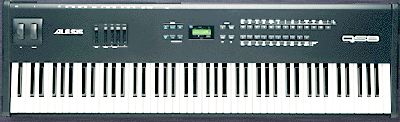
Well, I've used the QS8 for a while now and I have a few things to say.
First, I should start by saying that I've typically used SY22, SY77, SY99, VL1,
Disklavier, Korg I4, some Proteus racks, and a variety of sampling and tone
generator units (again, these are mostly Yamaha). For the price of the QS8, it's
a nice buy, particularly for people that want to add some muscle to their sound
engine (64 voice polyphony is VERY nice). The QS8 is an excellent keyboard for
people that are looking to buy their first, and also for folks that enjoy
making music as a hobby or for local gigs and so forth. However, I've read some
of the comments that other folks (below) have written, and I'd like to discuss
some differences I've noted between this unit and others I am using. First,
although many of the sounds are very nice, in comparison to units like the SY
series, they sound somewhat dry. Now, this is a somewhat unfair comparison to
make. The SY series keyboards run up to some $9K for the SY99 (now discontinued,
unfortunately). The QS8 is only about $1.2K. The QS8 is unquestionably value for
your money, especially when you consider that many of the SY-series only feature
48-note polyphony. I only mention this because it's a mistake to think that one
is getting high-end sound control from the QS8. The QS8 is (I believe) FM
synthesis technology, and, to a seasoned acoustophile, it definitely sounds less
rich than AWM synthesis. In terms of usability, the QS8 has a less easily
understood interface than is available in the SY, and I-series synthesizers.
In fact, I would probably say the Alesis is one of the most complex
architectures I have ever used. In order to take control of it's effect send
architecture, for example, you need to consult tables on how it's routing
and effects operate under a given configuration. Sometimes it can be unclear
what effects are available and at what times they are usable. In comparison,
the SY series has on-screen menus that make it more clear and intuitive what
effects are in place and under what conditions they are operating. The I4 is
probably approaching the QS8's degree of complexity in effects patch
programming. I am still having major difficulties working with this synthesizer
and MIDI. I have my entire studio running on Vision 3.5. This is the only
synthesizer in my studio which distinguishes between mix and program key events,
the result of which is that it is generally a major hassle to record program
sequences destined for mixes, the keyboard won't play program sequences in mix
mode and won't play mix sequences in program mode. With some tweaking around,
this can be worked around, but it's a pain in the neck. I'm not sure you could
call this a "problem", but it sure does take up your time dealing with it. I'm
giving this keyboard a 3 out of 5 because it's a good keyboard worth adding to
anyone's collection (particularly novice users), but demanding/high-end users
should be aware of it's synthesis limitations and somewhat difficult programming
interface.
|