|
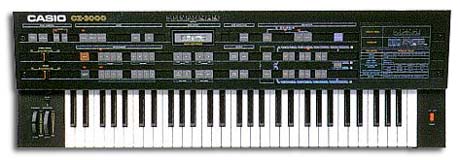
The CZ-3000 must have been seen as quite a competitor by Korg and Roland, and in a smaller degree Yamaha, as well, when it was released in 1986. Featuring an accessible new synthesis technique and build quality that was better not only than mid-80's Korg (which isn't that difficult), but in my opinion also than Roland - indeed, my experience tells me that Casio was right up there with Yamaha and Akai.
The Phase Distortion synthesis was an excellent compromise between flexibility, ease of use and the sound. Certainly, FM synthesis offers you more ways to nuance your sound, but it's less intuitive than PD and the sound tends to be less warm. By laying out the controls similarly to traditional subtractive and at the same time adding various features that the digital realm can easily provide - such as the 8-stage envelopes - Casio created a powerful synthesiser with unique sonic possibilities.
In use, the synth possesses somewhat steep learning curve at first, but once you get round to it (preferably with a manual in your hand), the results are predictable, which I can really appreciate. And how do they sound? Well, with a little bit of work, they can sound great. The CZ-3000 can produce a filthily distorted, electric-guitar like sounds, rich brass sounds which hint at analogue, and mellow pads and stabs. As a reviewer before me noted, there is not powerful electronic percussion to be had, except for kick drums, which can shred your speaker - I'm speaking from first-hand experience here - and various rim-shot and woodblock sounds, if that's your thing.
In use, the CZ-3000 is extremely versatile and the sounds, despite their relative fatness sit well in a mix (to hear the CZ-3000 in action, e-mail me at sartre@siol.net). They are by no means realistic, but the 1980's were a decade of synthetic sounds and I love them all the more for it. I have to agree that the presets were somewhat poorly chosen by Casio: not that they're particularly bad, they just don't do the synth justice. The A-1 preset is, for instance, probably the obligatory "Jump!" brass. This sound can be immensely improved upon, up to the point that a few fellow synth-heads mistook it for an analogue synth. That's not the point, though - the CZ-3000 is a versatile digital synth that can be made to sound seriously great - if you can't do it yourself, there's an entire network of enthusioastic users on the web who'll be glad to give you a hand.
If I like the CZ-3000 so much, why did I sell it just yesterday, I hear you ask (how did you know that, anyway?). Well, to buy the CZ-1, of course, the flagship model that offers more user memories and, more importantly, a velocity- and aftertouch-sensitive keyboard. Yes, I like the keyboard action of the CZ-3000 so much that I'm actually use my CZ-1 as a MIDI controller. It's one synth for which I know will deliver on stage, both as a reliable keyboard and an indispensable sound source.
As an afterthought, kudos to Casio to have chanced their arm in the professional market a good 15 years ago. The CZ series should have cut them a bigger slice of the pie, but the failure to make their name among the big ones eventually dragged them down. Still, we were left with an excellent line of products who should be bought off from kids trying to learn to play the piano and put to some serious studio and live use. Excuse me while I go and buy me the CZ-1!
|