|
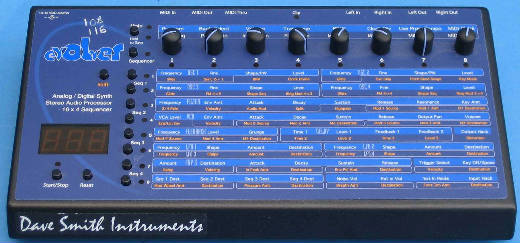
I know that I'm late to the game on this, but have finally grabbed an Evolver after playing with it at a couple of NAMM shows. I don't know if I'm adding anything that isn't already known, but it works for me so here goes..
-Fatter bass/pad sounds
Set the same sound in both channels (detuned saws, for instance). With the filters at the 24dB setting, increasing resonance cuts the passband as on the Moog filters. Set Envelope 3 to minimum attack, maximum decay and release, and sustain to maximum. This "creates" an offset, a continuous "on" signal while the keys are gated. Modulate one filters' resonance up (just one), or of the overall resonance level is high, us it to modulate one filters' resonance to its minimum. You get the resonant character plus the size of the non-resonant filter. Use Tri and Sine waves on that side too.
Set Pan to Non for center.
-I don't find it to be really punchy, but this is easily dealt with by setting the envelopes to linear, and using a Mod to modulate AmpEnv All by itself (lin through log responses with positive and negative self-modulation).
This is of course fun on the filter envelopes as well.
-More vintage character
Oscillator Slop, set at 5, doesn't come close to the Moog and other old-timer movement, so add slight (1 or 2) LFO to pitch modulations, with individual LFOs per oscillator, and a touch of LFO to LFO rate modulation. A tad of Envelope 3 to pitch helps as well.
-Don't miss out on the 12dB filter setting.
The 24dB setting has much more resonance, but the 12dB setting can sound nice and plucky, and do nice slightly fuzzy pads etc.
This is only approaching the instrument as a keyboard plus tone source device; I haven't touched the sequencer yet, and note many excellent factory programs using it for multiple-part harmony and timbrality. Some folks did some killer work here.
-Inside the Evolver
The PCB, Rev 1.5, has "Yeee-Ha!" on it :-)
There are Analog Devices OP275 opamps on the output section. This is a surprise; they're not cheap but have great specs, so Dave has paid attention to sound quality (I think that it's a good-sounding instrument, even with overall digital conversion involved).
-Oscillators
Yes, I know that there is digital involved, but I've been a fan of digital waveforms through analog filters for a long time. The analog-waveshaping oscillators have a nice character and a wide pitch range as well, and a nice hard sync tone. The PWM isn't quite as sweet as the Juno, IIRC. The digital oscillators alias more than I'd expected in a 24-bit DA system, so I use them at lower frequencies with the analog-waveshaping oscillators for hf stuff such as Triangle waves to add harmonics etc.
The instrument sounds clean, but not clinical, and lacks (thankfully) the "brazz" of somem DCO synths.
There is a touch of noise, but that's okay.
Clavinets and bells just pour out of this thing. I usually don't program clavinets either (ION found me making some brass patches, and I don't usually go for those either; interesting how different synths have different "voices" depending upon all of the different tonal and parameter aspects). This is a great device for pads, percussive tones, filter sweeps, leads, bass, SFX, etc. It has a wide range of strong results.
Fear the PolyEvolver! If you like the Evolver, start saving now.
|