|
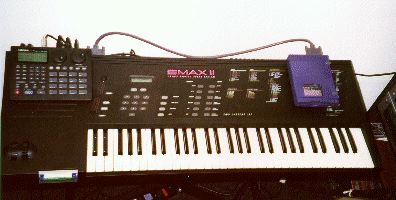
I've had my Emax II since 94. I upgraded from an Emax-SE.
Ease of Use: The OS is by far the easiest to work with. When I first entered the world of sampling, I looked at Akai and Roland and took test drives of each at my local studio. I kept saying, "What the f*** is going on here?" when navigating the menus. With the Emax, you can be one step ahead of being retarded and figure the whole things out without resorting to a manual. This is good OS design. Rating: 5
Ergonomics: The keyboard feels really cheap and toy-like. It has somewhat of a springlike motion but the keys clack back in place rather than bounce back like a Roland keyboard. The unit is monstrously huge and if their marketing called for "bigger is better," that would be the reason for it. Too big to carry around from gig to gig. Rating: 3
Sound Quality: Overall, a good decent sound. It is quite muddy as one reviewer called it, but that's compared to the newer samplers. Compared to my E4XT Ultra, there is no contest. The Emax II sucks by comparison.
I think the reason why people say this sampler sounds "warm" is because there's no top end on it (sample rate goes to 39kHz). Aside from this deficiency, you can get some pretty nice sounds out of it. The synthesis section is fun, but painfully slow (especially the multiplication function) so I stuck with mucking with existing samples instead of creating ones totally from scratch.
In a recording situation, I found myself adding my own top end to it during mixdown. Cymbals were never crisp or clear. Bass sounds got bassier, which was good in an Ensoniq Mirage-like way. What you put in usually didn't come out the same way. Rating: 3
Sample Libraries: I had an extensive library from my Emax SE and loaded all of the samples onto my Emax II hard drive. All work flawlessly. There are a few Emax II CD-ROMs that E-mu charged some large price for, so I never got them. Other than that, your options for sample libraries are pretty limited. To me, this was like trying to figure out which was better, an Apple II (the Akai, with all its available sample libs) or the Commodore 64 (the Emax II in this case). Sure, the Commodore was potentially more powerful, but it didn't have all the software of the Apple II! Rating: 1
|