|
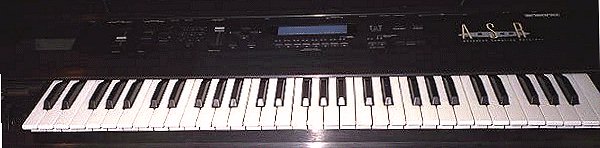
Two things really attracted me to the ASR-10. Firstly, the studio-in-a-box concept &, secondly, the ability of the ASR-10 to resample sounds through its internal effects processor. Even today this is something several samplers (i.e. the Korg Triton) can't do!
Although recording to a PC or a dedicated digital recorder with real knobs & faders is far less cumbersome, I can report that the ASR-10, with a fair amount of "nursing", is able to operate as a production studio. Around 1998-99 I recorded an entire album using my ASR-10 & a Seagate Barracuda 2.1GB 7200RPM external SCSI hard drive. I would not really recommend audiotrack recording to anyone unless they have increased the ASR-10's internal RAM (I specified 16MB RAM & SCSI at the outset - loading sounds takes all day using the ASR-10's floppy drive - a ZIP drive makes much more sense). Basically audiotrack recording worked as advertised. I was able to bounce audiotracks together & to themselves, repeatedly, through effects (usually the 44kHz reverbs & the 44PARAM EQ effect) without any trouble. Everyone raves about 24bit 96kHz recording now, but I thought that the Ensoniq-controlled recordings I did sounded great. If all you've ever used are analogue portastudios or even PC's with mediocre sound cards you'll hear the difference immediately! The only problems I encountered using audiotracks pertained to the ASR-10's achilles heel - its bug-ridden on board sequencer! To prevent crashes I saved SONG+SEQ & BANK data frequently. Even so, I was never able to get the audiotrack punch-in function to work. This meant I had to perform vocals in single takes! Nowadays I record to a Fostex VF16, although I still perform much of my sound design & basic sequencing on the Ensoniq.
It's as a sound design beast that the ASR-10 still shines. I'm into a lot of what, these days, they (Wire magazine) call electro-acoustic music. Not so long ago terms like ambient/industrial or electronica described similar territories. For creating wonderfully rich, unearthly sound effects & drones I have found the ASR-10 to be most effective. The trick is to resample sounds through effects & the MAIN OUT channel. The most prosaic & boring sounds can quickly be transformed into something entirely unexpected. All that's required is a little recklessness when it comes to selecting effect parameters. For example, resampling through the 44CHO+REV+DDL effect with heaps of reverb mix (70% or more) & chorus regeneration quickly smooths almost anything out into an unearthly drone. String sections, guitar sounds & the like often sound wimpy/cheesy straight off disk. Try resampling these sounds through the COMP+DIST+REV, CHO+DIST+REV (with the Q values set ludicrously) or guitar amp simulator effects for instant sonic demolition. These 30kHz effects are also good for "adding" a lo-fi "warmth" to sounds. If things get too murky you can always resample through the 44PARAM EQ effect to add sparkle. Some people have complained that the ASR-10's effects sound a bit tinny. I think these opinions are bound to be subjective. Before I purchased my ASR-10, my main effects unit was a Peavey Addverb II - this was definately much noisier & murkier than even the 30kHz reverbs on the Ensoniq. I still find the 44kHz reverb a good all-round effect. The 44LUSH PLATE effects are even shinier, yet add a warmth that my newer technology Yamaha REV500 (20bit converters, 32bit processing) takes a fair amount of twiddling to emulate.
I've never really used the instruments that came with the ASR-10 or on the 4 Invision CD-ROMs I own except, perhaps, the GRAND PIANO. Although this instrument must be pretty long in the tooth by now, I still really like it & use it a great deal in my song/lyric music. Other sounds, available from CD-ROMs, that I've used, have usually been customised to a considerable degree - but that's what sampling & sound design are all about!
Considering that EMU/Ensoniq have washed their hands of the ASR-10 I couldn't really recommend one to a prospective buyer unless the price was really right. There is quite a bit of third party support out there, but with older, 2nd hand gear you always have to take a calculated risk. I will say that, in the 5 years I've owned my ASR-10, only recently did it develop power supply fuse problems which were easily & inexpensively fixed. I would recommend any buyer of a 2nd hand ASR-10 to get one with expanded RAM (10MB at least) & SCSI. If the manual comes with the machine, so much the better. It's BIG, but well written & crucial to getting the most out the keyboard. I believe the ASR-10 manual can still be downloaded from the EMU/Ensoniq website.
Lots of people had problems with the ASR-10 in its early days. I believe these can be attributed to a combination of OS bugs (particularly the sequencer which will NOT perform to its theoretical limits), dodgy power supplys (or uneven mains power - you should run your ASR-10 through a line filter like any computer, I suffered less hangs & crashes when I bought one) & faulty or damaged RAM. My ASR-10 was a late model with the LCD display & OS3.53. Once I bought a line filter & learned to "nurse" the sequencer it gave me very few problems. It's still a fabulous machine, it still sounds really good. I'm still discovering new ways to create sonic bliss & mayhem on it. One day I suppose it will finally stop working - but may that day be a long way off!!!
|