|
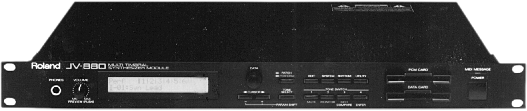
In the past fifteen years, the Roland JV-series, together with its offspring, the XP- and the XV-series, has become quite an institution. It took the JV-1080 to really establish Roland as the industry leader but the JV-880 and its keyboard counterpart, the JV-80, were already strong contenders when they were released in 1992. Just about every musician I ever went to see in their studio had one or the other and it sort of made me think I needed one too, even though I don't really like sample playback synths. So I bought a JV-880 and tried hard to integrate it into my set-up but while it proved to be a competent and great-sounding ROMpler, it also turned out to be a pretty weak synth.
Even though I had the JV-880 for several years, yet I could never quite get the hang of the interface. My number one gripe with it was that you had to pay too much attention to the front panel while you were simply trying to programme an honest patch. All too often, I inadvertently selected the wrong combination of tones and irretrievably ruined some of the edits I'd made. I'm sure there are many users that find it quite intuitive, and I'm glad for them, but it was enough of a problem for me to eventually stop using it altogether - and don't even mind the "painting the hall through the letterbox" approach all that much. Even when I managed to avoid any major cock-ups, I wasn't too impressed by what could be achieved by programming it: the Time Variant Filter proved little more than a glorified equaliser and the Time Variant Amplifier was only good for sorting out the attack and release times for individual tones in layered patches.
Luckily for most users, the JV lends itself well to not being programmed at all - in other words, its presets are great if that's what you're looking for, and especially after you flesh it out with the expansion card of your choice (it only accepts one, though it's always funny to go through the user patches after you install a new one with the old settings referencing new samples), you have a very capable, 28-voice polyphonic, 8-part multitimbral bread-and-butter sample playback synth, even by today's project studio standards. There are persistent rumours that it actually sounds better than the later Roland models due to superior D/A converters - the bass is supposed to be thicker and the trebles less aliased - and that its MIDI is tighter because the newer units are alleged to have underpowered CPUs that's can't handle the polyphony; unfortunately, I never had the chance to make any comparisons of that kind. I did use it alongside the Yamaha TG500 for a while, and I felt that Yamaha's twin SPX effect processors alone made a huge difference, yet I also preferred the character of the Yamaha, which was considerably punchier, edgier, and more upfront.
So even though I didn't like it very much (it only made it onto a couple of my tracks - feel free to get in touch if you'd like to hear them), there's no doubt that the JV-880 is very good at what it does. Also, there are a lot of features I found useful and well thought out - four audio outputs configurable as individual or stereo pairs, on-board chorus, reverb and/or delay, 1U rack format, the supremely handy preview button - and the general construction quality is mostly beyond reproach. The only problem I ever had with it was the rotary encoder that doubles as a push button, which had to be replaced due to dust build-up. Finally, I was pleasantly surprised at the resale value these instruments seem to hold: having bought my unit second-hand, I hardly lost any money in almost four years, which is one last testament to the quality and popularity of the JV-880.
|