|
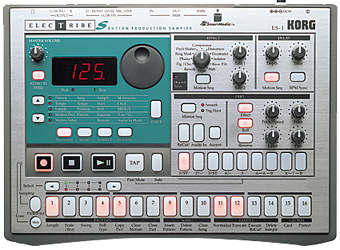
This review/comment is for those trying to decide rather to buy this or not. I have had it for maybe three months now, and absoultely love it. It was a good buy for $399 (US), and if it were stolen or lost I'd buy another one. I have had an EA1 so it was real easy to figure out. I use it mostly as a drum machine (you can download drum machine/drum sounds or any other sound you can think of from the internet all day) now I "have" a DMX, a TR606, a Linn Drum, a TR727, etc!
This sampler is more for drums, loops and phrases rather than playing different notes with (though you can change pitch with the pitch knob) It is designed with DJs and dance music hobbists in mind but can be used along side more expensive gear, and can be well used by a "pro" user. If one is imaginative they can complete an entire song on one of these. It is easy to learn and doesn't take away from creative process when being used since there isn't tons of displays and windows to go through. I have read opinions that this is cheaply made, with wobbly knobs and the like, but mine feels well built and sturdy. I don't gig out, but if I did I'd pack it in a hardcase with foam about the sides and keep it away from fluids just as if it were made of pure steel.
Most importantly this machine is user friendly, you can turn out a song real quick with your imagination the only limitation. I'll be using this for decades to come so I'll have to stock up on some smart media cards just in case they become obsolete.
cons: 1)though it has 11 different effects, only one can be used at a time (ie. you can't use disortion on one sample and use pitch shifting on another sample -it's one or the other). I'd rather have two more individual outs than have the effects. 2) samples don't cut off when you take your finger off the pad or when the pattern ends. You have to truncate your samples down to where you want them to end because they will play into the next pattern (maybe this will be good for some musical ideas or tricks) 3) if you are not using a computer to edit your sample sounds to put on smart media I don't think you can really get into your sample with the es1 other than truncating start and ending points, normalizing, and fade outs (which are fine on their own). 4) the accent is global and adjustable by the level knob. IMO I don't think it's very musical 5) the onboard triggers aren't velocity sensitive but can receive velocity sensitive MIDI messages.
Pros: 1) one can switch the sample sound while the pattern is playing 2) editing wavs & aiffs on the computer is easy with Nero wav editor, creative wav studio or other software. I sit back let a record play through my computer and if I hear any sounds I would like to sample, I record it on my computer as a wav and save it for later. When I get around to it I'll play around with that sample (saving the original sound)I convert it to 32khz drag it to the smart media and feed it to my ES1 3) programming patterns and chaining patterns to form songs is very easy, your imagination is your only limitation. I usually map out my idea for a song on a piece of paper (eg. intro-->verse 1-->pre chorus-->chorus-->verse 2.....) then I write down what pattern is what (eg. a34=verse 1, b20=chorus) mapping out the song can be useful if you're using other gear that uses this style of sequence programming, because you'll know where a breakdown starts, where a chorus starts etc. 4) 6/a, 6/b, 7/a and 7/b can be used like a high hat open-close with x/a as the open and x/b the close as found on drum machines. This can be useful for high hats, for samples you want to cut off, and I'm sure other uses I'm sure I'll discover. 5) saving your samples, patterns, songs on your computer is easy with the smart media card. you can label each save so you don't get confussed what you're loading.
|