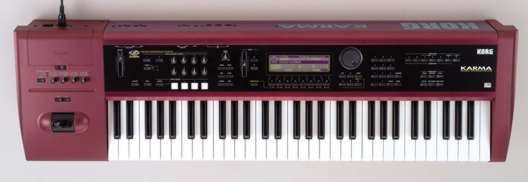
|
After several hours of preliminary playing I would say the Karma is an excellent tool for exploring musical areas not traditional to most synthesizers. I felt and still do feel the Trinity had a different, and to me, more complex sound than the Triton. So the Triton sound set or any other are not of primary importance to me on this synthesizer.
Reading some of the remarks it is obvious that people are judging the Karma mostly on it's sample set and more traditional issues such as features left out. Reading the "I" series mailing list and at the Gas Station you get similar dislikes from disimilar users. "It's a toy" say people that do not like sample playback synths. These people seem to be analog oriented and smash VA synths as well. The "I" series people find the Karma not as useful as traditional arrangement keyboards because it gets too weird and doesn't follow traditon all that much.
Here's where I stand. You have a good sample set to work with so the Karma has reasonable value right there. It is missing the sampler section, ribbon controller and touch screen UI (although the interface on the Karma is still very functional) and the Triton v2 arppegiator which means on the surface you can only use preset arppegiations. But really you have many variables to work with on the Karma. Let's say you find the lamest preset you can find. You can program the GE (generated effect) or assign a different one. For this example let's say you use whatever GE is part of the lame patch.
Now, you have the Triton sample playback engine to work with. It works decently to my ears. You also have 400 parameters to work with using the GE assigned. Don't like the assigned properties? Change them! Tweak the realtime knobs and buttons. Think of these variables like an analog synth but instead of changing timbre (which I would agree is limited compared to some VA and analog synths) you are also changing the way the GE process of the Karma synth interacts/works. You can mold sound and all kinds of performance articulations, gestures and dynamics. In this sense you have a synth that is wildly adaptable to those willing to learn it.
I remember when the Wavestation came out and the critics loved it. Users didn't. They liked M1's, they liked Proteus. They wanted the sound that made sense at the time and sample playback was it. Right now the hot items are split between sample playback/sampler units, VA's and analog synths. The Wavestation's sales sucked. There were not many realistic timbres, it didn't have a piano, drum kit and so called real instruments. Korg upadted the Wavestation to the EX model which kind of had some of the more popular features of the day but the board didn't catch on.
The Karma has gone the opposite route. Decent and complete sample set but change the way the keyboard interacts with the player, from simple manual playback to massive tweaking of performance articulation.
It's not right for everyone but it's far more complex and useful in MANY styles of music than a JX-305 which does dance oriented tracks well but is nowhere near the depth in terms of timbre or interactive complexity. The Karma is more for the player looking to explore new ways of making music than staying within the narrow boundaries of most music arranging techniques. It always makes me laugh when something unique comes out and angers people that want something different as long as it is something they are used to hearing or emulates it decently.
I also use a Waldorf microQ and think it's a very interesting sounding synth. Not terribly convincing as an analog but also far more flexible than most synths I've worked with. To me this is a synth that helps explore timbre and takes you places that many synths do not go. That is it's forte.
With the Karma it is the same process but you have to evaluate your way of thinking about how music is made. I think this threatens people and may make the Karma a sales dog (though it's difficult to find one in stock.) In any case, I auditioned and tweaked it enough to purchase and be very happy with the synth and look forward to incorporating it into several upcoming projects.
4 for sound quality and programming 5 for interesting creation concept
Last thing, I'm not attacking anyone so don't take it that way. But put some perspective on what you are reviewing. It's one thing to say, "it's not my thing, it doesn't fit my music" and another to say it sucks or has a value of "x" amount of money. That tells me you do not connect with the instrument, not that it is of modest value. There's a lot of reviews here where users take their specific focus and judge an instrument on that. Be specific.
My uses are film/video, ambient, experimental/edgy music. For these styles the Karma is great. I can see it used for many other kinds of music, maybe not some techno styles, but in general there's a lot here for those who are willing to think slightly differently.
|