|
I reviewed the microKORG here shortly after I had a go on one at a showroom last November. At the time I was completely blown away by some of the sounds (but not all of them), and I was going to get one there and then except the shop was out of stock. Over the next few days I had time to reconsider investing in the micro. At the time, the £399 price tag seemed a little too high.
However... I was tempted again when I found the synth going for £325, which seemed a much better deal. I snapped one up and was instantly impressed. It seems to sound better at home than at the showroom and there were quite a few sounds that captured my imagination.
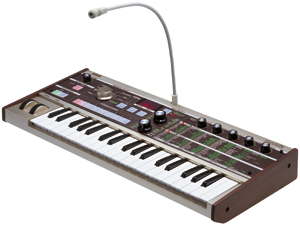
My first impressions of the microKORG are that it's really in a class of it's own and certainly has it's own unique sound. A lot of the sound remind me of the sounds we used to hear in tracks made by the Human League, Depeche Mode and other early '80s synth freaks... before everyone went crazy for the Yamaha DX7 in '83... And, while on the subject of the DX7 the front panel of the microKORG is an uncannily similar shade of brown to the panel of the original DX7. I also really like the styling of the microKORG - made the old fashioned way - and it really is real wood on the end cheeks! The mini keys do seem somewhat strange, and kinda make this Korg's 'freak of nature' which will probably never be seen again, but this was another factor that made me like it. It's physically very small and portable, but sounds huge!
I was particularly impressed with the microKORG's pad sounds and the clever way in which the oscillators on many of the pad programs have been tuned either a fourth, fifth or octave apart to make the sound bigger. I like the ones tuned a fifth apart since you can make really huge sounding chords even if you're only playing two notes.
Which brings me nicely onto the four note polyphony. This was one of the factors originally that turned me off the micro. For some pad sounds with long release times, obviously the poly gets exhausted too easily and sometimes unless you make sure you release all four notes before playing the next chord, not all of the notes will sound, which can be a pain if recording. Maybe Korg could have added just one extra note? to make it 5-note poly?
The vocoder is also first class. I remember when Quasimidi released their Sirius synthesizer that had a vocoder a bit like the microKORG, but it was much more difficult to understand. With the microKORG, almost everything is intelligible. I particularly like program A83 - a soft vocoder sound in fifths.
As regards the overall sound quality of the microKORG, it does, of course, sound analogue, but it is possible to hear digital quantization of the sound at times - for example if adjusting the resonance level really slowly, it is possible in some circumstances to hear the stepping effect of each discrete value. The likelihood, however, of adjusting a parameter at such a slow rate in a performance or recording situation is highly unlikely and would probably not be perceptible within a full mix anyway.
My final verdict on the microKORG is that it brings high quality analogue-style synth sounds (and the microKORG really is a synth - no GM pianos here!) to the lower budget market and also includes a very capable vocoder - something which would have been hugely expensive not so long ago. Congratulations, you've done it again Korg!
|