|
I’m surprised there are so few reviews for a synth that’s been around close to two years already. Maybe that says something?
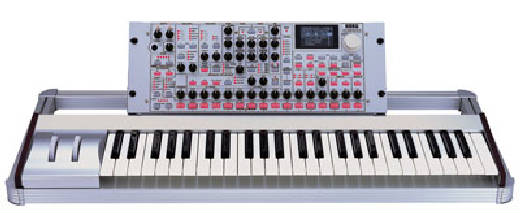
The Radias is the next step beyond the MS2000, while the engine inside may be all new the user interface is quite similar as is the annoying location of jacks and power switch when racking the unit. What’s been updated from the MS2000: twice as much patch memory, a third EG (hidden in menus, no knobs), one morphable filter (you can sweep through filter types), a second filter, waveshaping, four timbres vs. 2, dual FX processors for each timbre, improved global FX processor (yes, it has reverbs now), major polyphony increase (from 4 to 24 voices), FM (Korg calls is VPM), two more “virtual patch� (mod matrix) slots, drum PCMs, improved vocoding and two assignable step sequencers.
It’s a VA synth but not very vintage sounding, too bright and crisp. With three mod sequencers per timbre, two step sequencers and an arpeggiator feeding up to four synth layers plus a vocoder it’s a natural for creating massive evolving sounds that would require a room full of analog gear to duplicate.
Like most VAs, programming looks simple because of all the knobs but there is a good amount of menu diving to reach the full depths of the Radias. Luckily moving any control causes the appropriate menu to be displayed so navigation is painless. You can also use the 16 sequencing buttons along the bottom of the unit to jump to specific menu pages (these buttons also double as a way to select programs).
Those 16 buttons can also be placed into a triggering mode where you can mute and unmute individual steps in arpeggios and sequences while they play, making for a lot of fun in live applications. It’s a good thing, too because the arpeggiator is otherwise very basic: up, down, two alternating modes and random. The step sequencers are polyphonic, by the way: each step can trigger up to 8 notes. Each has 32 steps max and you can chain them into a single 64 step sequence if you want. You get all the expected choices: transpose or fixed pitch, use key velocity or not, etc. Each step sequencer as well as the arpeggiator can have it’s own step resolution. The resolution for the mod sequencers can be different for each timbre but it’s shared for the three within the timbre.
The PCM waves will be viewed by many as a waste, but it does mean Radias can cover some emulative roles (esp. electric pianos, organs, strings and drums) as well as a sample-based synthesizer. The VPM mode is a real treat: program useful FM timbres with just two knobs and it stays in tune even at the most extreme settings. More traditional osc x-mod is also supported. There’s a tunable formant waveform and pitched noise available which saves you the trouble of creating your own with BPFs. Bad news: no PWM is possible with the second osc and oscillator tuning is limited (you can detune osc2 +/- 4 octaves from osc1 but you can’t detune osc1 itself).
The two filters add a lot to the sonic palette. The first one can be swept freely between 4 pole LPF through 2 pole LPF, BPF, HPF and finally no filtering at all. The second filter has selectable 2 pole LPF, BPF and HPF modes plus a comb filter which opens up a range of plucked string sounds. You can use just one filter, both in series or parallel or assign one filter to each oscillator.
The two LFOs are quite basic. Both offer saw and S&H waves. LFO1 routed to the oscillators adds triangle and bipolar square, LFO2 routed to the filter adds sine and unipolar square. Additional mod routings are handled through the “virtual patch� feature. In the OS 2.0 this has been expanded nicely to let you modulate all the EG slopes (cool) and even modulate another virtual patch. For example: use VP#1 to route LFO1 to control pitch then use VP#2 to route LFO2 to control VP#1 intensity and you get vibrato at the rate of LFO1 that varies in depth at the rate of LFO2.
Buried inside the Radias is an envelope follower which can be used with the external audio inputs but also can be patched to the output of any timbre via an internal bus. I haven’t figured out a good use for this yet but those with a taste for weird noises will probably find something to do with it.
I haven’t touched on the vocoder but the big news here is you can record short vocoder sequences of up to 7 seconds and then play them back at a later time. You can store 16 of these on board. Of course real time vocoding is supported as well.
In the output section, there are four jacks, a main stereo pair plus two aux outs. You can pan any timbre anywhere between these, allowing for surround mixing. Alternatively, each timbre can be output individually for external processing.
The USB interface can be used for OS upgrades (latest is 2.0), running the supplied Mac/PC editor/librarian software and lets you use the Radias as a MIDI interface for external gear.
MIDI is very well specified: for sequencing use each timbre can have it’s own channel and message filtering, all knobs send CCs which can be remapped by the user, the step sequencers and arpeggiator can drive external gear (each on it’s own channel) and thank goodness Korg still believes in the need for a MIDI THRU (hello, Roland). A really slick MIDI feature is the clock mode that synchs to MIDI if a MIDI clock is present, otherwise it uses the internal clock…hooray!
Build quality is good, not great. The case is metal but the pots appear to be attached to the PC board underneath so they can be flexed (bad).
Overall the Radias is going to disappoint users looking for fat Moogy sounds but those into evolving textures will find a lot to like here.
|