|
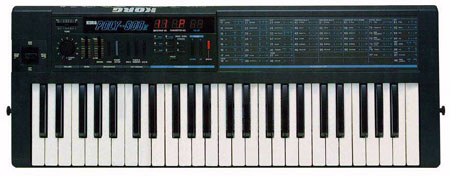
Especially when taking into account the second-hand price, you'd think that the Poly 800 would make a great beginner's synth...but I can tell you first-hand that it doesn't. Its user interface is tedious (parameter-value), the advanced envelopes confusing at first and the flimsy buttons don't help very much. The only feature that would benefit from digital control, the step-sequencer, has a slider to set its tempo. Go figure.
Furthermore, the results of the programming were, at least for me, rarely gratifying. Korg Poly 800 doesn't sound very good, full stop. I believe that the culprit for this are the oscillators which have a strange disposition towards producing square wave overtones, regardless of their setting. Hadn't this sounded so plasticky, it could've been something that people would go for, but it's merely annoying as it is.
It's attractive price makes the Poly 800 a favourite among the modders and some modifications are great, notably the installation of filter cut-off and resonance knobs and the "Moog slayer" filter mod. (Refer to a search engine for more info, my Poly was left unmodified.)
If you decide to buy it still, make sure you check it out thoroughly. I had noting but bad experience with mid-80's Korg build quality so I might be somewhat paranoid, but the keyboard scanning mechanism is in itself an example of poor engineering; and do check if the internal battery is still doing its job.
I spent almost a year with the synth. I made a few good sounds, but not a single unforgettable one (e-mail me at "sartre@siol.net" to hear it in action - synthpop warning!). I'm not a terrific programmer and it's perfectly possible that I didn't make the best of the Poly 800. I sold it yesterday, for exactly the same price I bought it for. I can't be bitter about it at all therefore - the Poly will always be my first synth and the one that got me hooked on making synth music in the first place. I might miss it for sentimental value, but my later acquisitions (both analogue and digital) will not leave me craving for its sound and/or functionality.
|