|
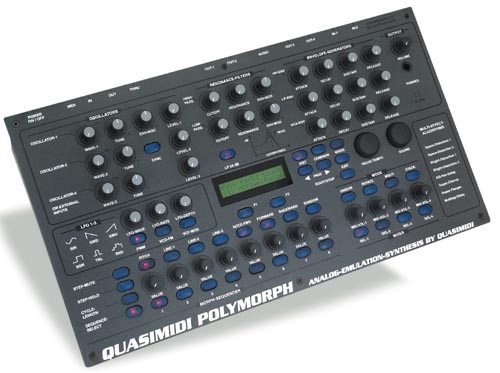
This is a solidly built unit, made of sturdy metal that is reassuringly strong (I don’t have to worry about it breaking while I move it like Korg Electribes.) The knobs on my unit are quite smooth and not wobbly at all. Its heavy but not as dense as the Virus is (both are very very well built units)
You have three oscs, one dsp based osc and two sample based oscs which can be replaced by external signals. If the third osc is used (either a sample or external input) the polyphony drops to 8 voices from 16. The second osc can be synced to the DSP one resulting in harsher tones. The VA osc can only be tuned up or down in intervals on an octave (-2, -1, 0, +1, or +2) but the sample based ones can be detuned nicely. The pitch of the VA osc can be modulated positively or negatively by the amplifier.
There are two filters, a highpass and a lowpass both with resonance. The lowpass filter is switchable from a 12dB/oct Oberheim style filter to a 24dB/oct “moogish” filter. The resonance on both can be screeching or booming depending on the settings.
There are three LFOs per voice, one for PWM, one for frequency/pitch and one for the filters. Tri, Sin, two sawtooth waves, and a random wave can be selected. Their rate can be set in arbitrary values from 0 to 126 or can be set to divisions of the internal sequencer (ex: a sin wave that takes 16 steps at 120BPM to complete a cycle.) Don’t expect the pitch LFO to do FM… the osc doesn’t appear to be able to reach audio speeds.
There are three envelopes per voice, one for each filter and an amplitude envelope. These can be used to create anything from bleeps to long pads. The envelopes aren’t fast enough to create any tight kick drums but can create punchy basses with ease. That said, usable kicks can be crated but they’re nothing compared to the ones that can be created on the Virus.
The sequencer can have up to 16 steps and has four separate sequencers per part. One sequences pitch and the other three can be used to modify almost any parameter on the machine. My favorite parameters to sequence are filter cutoff, panorama, and the waveforms of the individual oscs. When using the sequencers carefully, one can have a completely different timbre per note. The sequencers are great but they have one main flaw: you can’t chain together sequences to make a song. The sequencer also won’t transmit MIDI note data without turning the machine into “local off” mode in which case the Polymorph won’t make any sound… so you can either sequence an external device or the Polymorph, you can’t do both.
There are four effects available per part, two multieffects processors (one mono, one stereo,) distortion and EQ. This means that you have effectively 16 effects processors to use on all your sounds (but can only have 4 per part.) They’re all highly usable. Time based effects (such as delay or flanging) can sync to internal clock. The distortion is particularly nasty and works best on monophonic basses and leads. EQ is EQ, ‘nuff said.
SO HOW DOES IT SOUND?
Well?
It covers a lot of sonic ground from Kraftwerk to evil EBM (think Wumpscut.) I use it for industrial and can honestly say that it’s an INDUSTRIAL HELL MACHINE! Does it sound “analog?” Yes and no. It can put out a bassy wall of sound like a Minimoog being run through a distortion pedal… but I’d be hard pressed to get pure liquidy analog sounds out of it. It doesn’t sound like a Jupiter 8 or a Matrix 12. It DOES sound like a raw, brooding, powerful machine that can either belch out nasty buzzes of sound or make eerie atmospherics. I wouldn’t recommend it for people in 80s cover bands, nor would I suggest it to those that make house music or 303 filled trance. It’s a machine suited for the hard and the dark or the painfully beautiful. Do I still want a Virus? Yes, but that’s to cover vanilla analog sounds. There’s a lot of overlap between all the Vas on the market, but simply put, nothing (and I mean NOTHING) sounds like a Polymorph.
If you want to hear my Polymorph doing its “nasty industrial thing,” check out “Fun with the Polymorph” at my mp3.com site. For the lighter side, listen to “Nothing” which is another all Polymorph track. http://www.mp3.com/LyticCycle
~Brandon
|