|
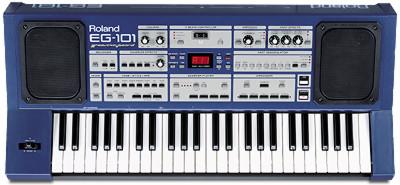
EG-101 gets a second chance at life: I bought this EG-101 new in 1999 or 2000. I was pretty disappointed after a few weeks. Talk about not doing my research: I quickly found out you can't program your own beats or sequence stuff or program your own synth sounds! I couldn't believe Roland made such a useless device. I should have returned the thing immediately, but somehow I kept it. I wanted a workstation for producing electronic music at home, and everything this did was lamesville. At one point about 3 years ago it had been relegated to a plaything on the floor for my then 2 year old son, who regularly walked on the keys and buttons. If this is any testament to Roland quality, everything still works fine. A member of my band borrowed a MicroKorg and we jammed with it a couple of times, it seemed to really bring out some depth in our 4 piece guitar based sound, so we were bummed when it had to be returned. I dug the EG-101 out of the garage as a replacement, not expecting much. Well, I was pleasantly surprised. The machine sucks as a standalone workstation, but as a live tool it's much more useful. The microkorg had more diverse and complex sounds, but the roland was in some ways a better fit with the band. Sure, it ain't the best keyboard ever and it's 10 years obsolete, but it has several fat bass sounds, a few trippy patches, and some useful strings and pads. Enough to cover most situations, and they are less gimmicky than the microkorg sounds on average. The d-beam (sort of an optical theremin device) is actually quite expressive if you take some time to learn it and avoid the cheesiest options. I use it almost exclusively to control the cutoff/resonance filters. I would ditch the vocoder/mic thing on the korg and trade it in for the d-beam any day, and I hated the d-beam when I originally bought this keyboard. Even though there aren't that many sounds on the EG-101, careful tweaking of the cut/res knobs will make several variations on each. It's built-in speakers are loud enough to work as decent monitors at medium volume, and even at loud volume the added a bit of clarity. Since it has a mic input for the onboard sampler, I ran my guitar through a tube screamer and into the keyboard, then out to my regular amp. I didn't sample the guitar, I just left the sampler in preview/cue mode so I could use the filter and ring modulator effects live. Best use was too fuzz out the guitar with a pedal then adjust the filter sweep until it gave that tight compressed tone like old Queen/Bowie records. I would like a small mixer so I could switch from the guitar going in to using our drummer's mic mix. That way I could sample loop the drums, or run the effects over the drums live as he plays. I'm not saying you should go out and buy one of these, unless you could get it for under 125 dollars or so. There are plenty of better things available now, put the money towards that if you can. But if you or a friend have one of these gathering dust, or you see one for cheap, it's worth a second try. It sucks as a workstation but has some cool live creative options. I rate it a 3.50/5.
|