|
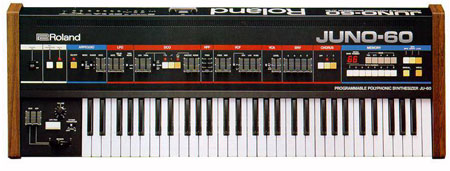
The Juno 60 was at two times a very popular synth for good reason, in 1982 it offered polyphony, stability and enough memories for under £1000, all in a reliable compact package.. in the early-mid 90s it was re-discovered as a dance synth, this seems to have fallen from favour in preference of the weaker but MIDI Juno-106. although the 60 could easily be MIDId via it`s DCB port and a converter, the implementation was hardly inspiring using the original Roland converter, notes only basically (NO PATCH CHANGES!) , maybe Arpeggiator sync, the newer Kenton kit does little more to the Juno, just filter via an AUX socket ... soo compared to the 106`s excellent spec and a proper well-specced internal Kenton retrofit costing as much as you probably paid for the synth. the 106 took over.
60s are reasonably cheap again and Yep, it sounds bigger warmer and deeper than it`s newer plasticky stablemate (like Oberheims, as they got newer, Junos got weaker sounding and had more and more faciltiies piled on). there IS a slightly earlier Juno-6 which is the same machine minus the Memories and DCB, big losses indeed. the two biggest 60 plusses soundwise are 1:- it has a lovely filter that actually self oscillates (unlike the Jupiter 8, 6, MKS80 and JX line). 2:- a wonderful chorus unit that makes thin 1-DCO+SUB pads sound absolutely massive, not particularily relevant to the Dance bassline / squeak-blip sounds but for pads, string washes and leads it IS the biz!. The Arpeggiator is excellent and useful, but is missing the famous Jupiter 4/8 Random mode.
Techie bits to note are that the Juno-6 uses the same woodwork, powersupply, keyboard, bend panel AND MOTHERBOARD (complete with the DCB connector pins on the scrapper I have, (wondered what they were for)) so if your tatty old 60 dies you can tidy the thing up (minus the panel) and fix it (so long as it doesn`t have memory board probs) for the price of mint JU6 (not a lot usually).. the Endcheeks WILL remove without replacing the whole case, they`re held with screws underneath and only a miniscule amount of glue and pull off without too much effort... the battery is easy to change as it is soldered to the exposed side of the memory board. Unision can be acheived via a switch on method that escapes me (hold trtanspose and switch on??).
Internal Converter wise, this one has the groove MIDI system in which is basically inserted between the DCB port and the connector on the motherboard, simple but due to DCB limitations, very basic, just notes on channel 1 (poly mode) as far as I can tell but has the added advantage to being possibly re-caseable in an external enclosure if you have a Jupiter-8 to serve as well (electronics heads only here (;-).
the Kenton kit is incredible ... MIDI Thru, MIDI Out (any channel) for notes and program change, MIDI In (any channel) for notes (5 octaves notes 36 - 96), program change, pitch bend, mod wheel, aftertouch, velocity, MIDI volume, any controller (assignable), sustain , active sensing, all notes off, omni on-off, reset all controllers.
Aftertouch can control: modulation, pitch bend, VCF (filter), Velocity can control VCF (filter), VCA (volume), Any controller can control VCF (filter), MIDI volume can control VCA. All setups are stored in non-volatile RAM.
BUT it costs around £265 UK for a DIY kit..
If you need an excellent easy to use polysynth on the cheap for standard Analog sounds, give one a go. Listen to Enya for non-dance uses of the machine, silky strings, subtle haunting arpeggios etc.
|