|
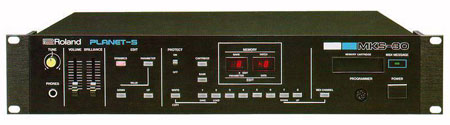
People often accuse Yamaha of wilfully combining great features and senseless limitations in their products, but Roland can be just as bad. The MKS-30 is a great example of that: on the whole, it's a nice-sounding analogue synth in the then-pioneering rack format but if the engineers spent only a little more time designing it, it could've been an all-time classic - and I'm not even talking about the missing MIDI out port (which feels as if it was done on purpose anyway, in order to stimulate sales of the PG-200 remote programmer).
I'm careful so as not to be unfair to the venerable MKS-30 as it occupied the lower end of Roland's line-up together with its keyboard predecessor, the JX-3P at the time of production in the mid-1980s - but on the other hand, so did the Juno-60, and time has been rather kinder to it, despite of having only one oscillator per voice, compared to JX-3P's two, and no MIDI. I suppose the fact that you more or less needed to buy a separate programmer to get the same sort of functionality out of a JX-3P didn't help with the synth's popularity, but it's the sound where the JX-3P and the MKS-30 don't measure up all that well to other contemporary analogue polysynths.
I'm the first to admit that the MKS-30 can sound very interesting due to its impressive oscillator modulation capabilities (drop me a line to hear some examples) - there is detuning, LFO modulation, envelope modulation, PWM, oscillator sync and even a simulated ring modulator, which doesn't really sound like the real thing but produces an interesting and unique effect nonetheless. What I do miss terribly, however, is unison. It's quite beyond me just why the engineers decided not to implement it as the MKS-30 would've benefited immensely just from this one feature. With the absence of unison, I'm slightly less disappointed about portamento not being there either, but I can only imagine what a magnificent bass and lead machine the MKS-30 could have been with just these two features included, especially since the resonant filter is pretty good and can even be driven into self-oscillation.
Curiously, I never felt that the MKS's single envelope was much of a limitation. The pitch, VCF and VCA amounts can all be adjusted independently, providing reasonable flexibility. The fact that the envelope is set to permanent legato mode - meaning that it will not re-trigger if you don't release the key before you play the next note - is another senseless limitation, though. Unless you're a skilled keyboard player, you'll often find yourself missing the attack portion of the sound and with no unison or even mono mode (the MIDI implementation chart in the manual proudly states "MONO ignored"), you can't cheat with long release times, either, so you'll have to resort to a sequencer for consistent lines.
Various additional features, such as HPF, filter tracking, basic velocity sensitivity (JX-3P had none) and the famed Roland chorus, albeit nice enough, can't really redeem the synth in my eyes at this point. It's a shame, too, as the MKS-30 is certainly a synth with some potential but sadly stifled by a few seemingly trivial design decisions that, added up, considerably limit its usefulness.
|