|
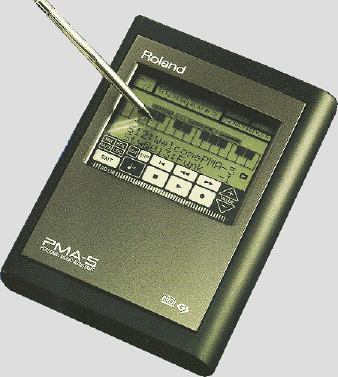
Review of: Roland PMA-5
Price paid: $416 (in Anchorage, no less, where there's no sales tax) Description: A portable music workstation, similar to those pen-based handheld
computers that don't recognize people's handwriting. Unlike the computers, the
pen-based system here is fairly easy to learn and use. Features: 306 voices (GM/GS), 16 drum kits, 28 note polyphony, MIDI in/out,
computer in/out, foot pedel jack to start/stop songs, 1/8" headphone/audio out
jack, 4-track sequencer with additional 4 tracks for song patterns, 100
built-in styles (6 variations of each), memory for 200 user styles and 20 songs,
various reverb and chorus effects. Runs on AC or 6 AA batteries. What it does: Just about everything. Enter chords and choose a style and it
can serve as a backing track performer. Use the on-screen keyboard to compose
or record (one note at a time). Hook it to a controller and it's a tone
module. When hooked to a computer ($50 for the kit, which is a must have for
anyone with a PC or Mac equipped with MIDI) it can exchange files with other
programs. Sound quality: The demo songs and styles will probably blow you away (I bought
mine on impulse after spending 45 minutes playing with it in the store), but
it's usefulness in the real world can be a bit more limited. I'd say the GM
sounds are generally about 80 percent of the quality of a Korg tone module
(based on the X-3 keyboard) I use for MIDI studio work. Decent results can
be obtained by substuting other built-in sounds. It certainly is good enough
for at least causal gigging and the demo proves someone with some patience can
wring a lot out of it. Impressions of use: Expect to spend a couple of hours learning the pen system.
Entering and editing songs using the built in styles and chords is fairly
easy, but a bit slow to those used to programs such as Band in Box. I find
the results much better however, EXCEPT the styles often have too much going
and there is no way to silence a voice (except during performance, which is
useless) unless you take up valuable memory by turning it into a user style. Its composing tool stuff looks intimidating, but is actually fantastically
simple to use and fairly powerful within its note-at-a-time limits. It bills
itself as a great way to try ideas on-the-road and I concur there. Its MIDI data is a little unusual, in that it limits volume to eight predefined
settings. So far I haven't found this to be a problem, but someone might. A BIG
plus if you buy the computer kit is the PMA can store and play GM songs,
overcoming the volume, track and other limitations. The price for this is
a hefty chunk of memory and most song parameters can't be edited. The biggest problem is memory: 21,000 notes. This is more than you'll ever need
if all you use is the built-in styles for backing and don't record melodies.
But if you try to download masterpieces from your computer to play on the road,
you'll find it woefully short - it can hold maybe one reasonably complex song.
The way around this, if the song is pretty straightforward, is to make user
styles out of 4- or 8-bar sections of the song and then just specify a C chord
for the whole thing so the key doesn't change. Speaking of chords, the PMA-5 has a serious limitation on available chords if
you're into jazz. Most chords to the 9th are available (no 2nd and limited sus4
though), but not much beyond. Again, user styles can probably overcome this,
but its something worth thinking about. Overall: I'd definitely buy the unit in the same circumstances, but the fact it
can do so much simply makes the few things it can't do that much more
frustrating. The one piece of advice I'd give potential buyers is to see
what Yamaha's new QY-70 costs and sounds like, whenever it comes out, since
it seems to be aiming for the same market and has better specs.
|