|
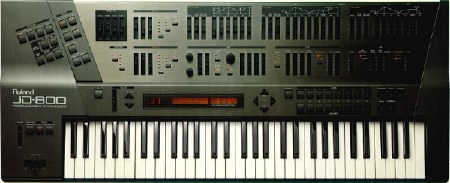
This information applies to the JD-990 as well.
I thought I'd include some info about the voice architecture. While the 800/990 tout 24 voices, they should really have said that it has 24 oscillators which can provide UP TO 24 voices of polyphony.
The voice architecture is just about the same as the JV line. That is each patch can be composed of up to 4 "tones" in Roland lingo. What this means is that you can assign up to 4 oscillators to a patch. The difference between analog synths and the JD/JV setup is that each oscillator is more like a layer because each oscillator get its own filter, amp env, etc. Because these engines support different filter types HP, LP, BP (and BR I think), you can have a pretty complex patch with an almost vocal character (if you know what you're doing).
The down side is that each osc takes away from the total polyphony on a 1 for 1 basis. If you have a patch with 4 tones, pressing down 3 keys takes up 12 voices. Press down six keys and you're maxed out. THAT'S why you hear complaints about polyphony.
Realistically, you should be able to create some pretty decent sounds with just two osc per voice.
You may also hear about the JDs sounding fuller and better than the JVs. This could be for a number of reasons, but since I'm not a Roland engineer, this isn't gospel. It's likely that Roland compressed the data on the JVs in order to include more samples at a bargain basement price. I've heard it said too that if you play too many notes at once on the JVs/XPs that it sounds crumpled and MIDI timing suffers. Obviously they are using different chips and this has bearing too. Lastly, there are the D-A converters. I have a feeling that Roland started scrimping on the analog components to squeeze a little more profit out of these mass produced boxes.
So it may well be that the trade off of polyphony is worth it. After all, I have a Matrix 6 and it's only got 6 voices.
|