|
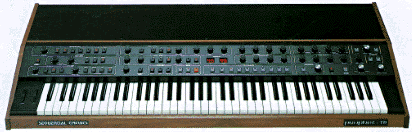
I have owned a T8 for over 6 years now. I am very familiar with it and the other synths that Sequential has made. People here seem to want to compare the T8 to the other Sequentials...if so then I have to say that the T8 is by far the best analog synth that they have made.
The T8 does share the CEM 3340s that are found on the Prophet 600...so it is similar to a 600 in that respect. But those chips are the exact same oscillators on all Pro Ones, Rev. 3 Prophet 5 and all double manual Prophet 10s. Unless your idea of punch from a Prophet involves unstable, untunable SSM chips found on the early 5's that always break, there is no difference in oscillators amongst the early Sequentials.
The big difference between the Prophet T8/600 and the 5/10 is the 5 and 10 use analog chips for their envelopes, the T8 and 600s envelopes are digitally generated by the microprocessor. It is often pointed out that these digital envelopes are slower than the ones on the 5 and 10 and that is very true with regards to the 600. But the T8 has a much more powerful processor. Not only does this prevent it from having audibly quantized knobs like the 600 does, it provides much faster envelopes. I brought a friend's 600 over and set the envelopes on it and the T8 to instantly open and close. I recorded these and viewed them in a wave editing program. The T8s envelope was twice as fast as the 600. I wasn't able to do this with a 5 or 10 but i have heard both in person, i do not find them to be any punchier than the T8 at all. The Prophet T8 is a Deluxe Prophet 5.
The thing that makes the T8 far superior to the 5 and 10 is it's touch sensitivity. The keyboard is wooden and weighted, but the way the notes change from modulation from the pressure and velocity controls offers facilities not imaginable on the 5 and 10. Pressure can positively or negatively affect the pitch of either or both oscillators, the filter cutoff frequency, LFO rate, LFO speed, Pulse Width and the amplifier. Velocity can positively or negatively affect the amplifier or filter cutoff frequency and it can also be used to speed through the attack and decay stages of the envelopes quicker for faster downward keystrokes. The T8 also responds to upward velocity, this can be used to lengthen the release stages for legato playing. All of this can be programmed into a midi sequencer for precise control of the sound. This is where the T8 outperforms the Prophet 5, because this can all be programmed so precisely into a sequencer it offers sound capabilities on an analog synth not previously available until the Alesis Andromeda was released. This is what keeps the T8 from being outdated.
Another feature on the T8 not found on most of the early prophets is the ability to split and layer sounds. This means you can have massive 4 oscillator per voice-4 voice polyphony. A Prophet 10 can do this and give you one more voice in the process...but personally I don't think that one more voice is worth sacrificing touch sensitivity for.
The T8 has an impressive midi spec as well. It transmits and responds to individual voice pressure on 8 channels in mono mode. This makes it an excellent keyboard controller for those seemingly common modern synths that respond to polyphonic aftertouch via midi but have only a mono sensing keyboard.
To be fair, there is one thing that the Prophet 5 can do that the T8 cannot. The 5's LFO can be routed to either pulse width of oscillator A or B or both. The T8's LFO only routes to both. But like the envelopes, the T8's LFO is digitally generated. The LFO here has a range of .005 to 40 Hz. That's a range far outside any of the early prophets capabilities. There are actually 2 LFOs in the T8, one for the left side and one for the right side. Oscillator B can also act as an LFO or as a tracking LFO. The tracking on the filter has a knob as well, not a switch for off/half/full. There is also a noise source, the famous Prophet poly-mod section, a crystal A-440 tuning reference, stereo outs with a pan knob, a scratchpad sequencer, chord tracking and ball-busting 16 oscillator unison mode. Unison mode can consist of 2 seperate patches for some real nightmarish sounds.
My only gripes about the T8 are few and trivial. It would be nice to have the LFO sync to midi clock...and it would also be nice if the LFO were routable to the amplifier. Also the springs on the hammer assemblies that give the keys their weighted action seem to break after a while. I had to replace a few on my synth when i bought it. I'll have to locate a spring maker soon as i only have 3 spares left. The noise source cannot be applied as a modulator which kind of sucks. Lastly, the knobs cannot transmit or respond to midi but this is asking a bit much of any vintage synth.
A few other T8-only abilities, it can use a sustain pedal to trigger a 2nd release time. Also there is an ADR switch that disables the sustain part of the envelope, this is very useful for creating piano-like envelopes which this synth seems to be made for. Great for those really punchy sounds that a Prophet 5 can't make!
|