|
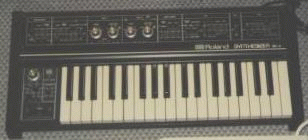
You are all correct: this is a superior machine. The Roland Synthesizer SH-2 is a really cool little mono synth and a useful studio tool as well. I was surprised at how many features they packed into this, which are all bizarre pre-midi analogisms. All the Seventies features were gone by the time the Juno 106 rolled out and the rest is history. Aside from that, it looks pretty 1979 from the way it says "synthesizer", right on the front in computery letters. Ok, lets go over the control panel from left to right: first is the LFO with square, sine and random waves, selectable by a little switch, and sliders for the rate and delay time. The random wave is necessary to demonstrate exactly what this instrument is, in case an onlooker is still confused after reading the aforementioned front panel synthesizer tag. There is also a tiny red LED that blinks in time with the LFO rate. Next is the oscillator bank, and the first chunk of that contains 3 sliders, a switch, and a little knob. There’s a modulation depth slider for pitch mod from the LFO, an autobend amount slider, with zero being off, and a pulse width slider. Next to that is the switch to select whether the pulse with is modulated by the LFO, the envelope, or manually by the slider. I really like that envelope mod on the pulse with. That setting might as well be labelled “funk”, ‘cause that’s what it does. Above all that, there’s the very small total tune knob. Next are VCO 1 and 2, both with 32’ to 2’ range, both with square, saw, and pulse waves, all selected by big, clicky, silver, Seventies stereo receiver knobs. The differences are that VCO 1 has a switch to turn off the pitch bend lever for just that oscillator and also offers a sine wave, and VCO 2 is detuneable and has white noise. The detuning is done with another very small knob, and a switch that changes it from coarse to fine tune. The knob is about the size of the eraser on the end of a pencil, which is annoying for such an important control. Look at the tuning knobs on a Minimoog; they’re the size of ritz crackers. Of course, on the SH-2, you won’t be retuning them every five minutes… I’m just saying… Having said all that, it is pretty easy to dial in the interval you want just by using your ears, and the next time you use the synth, it’ll still be at the same interval. It’s stable. The mixer stage is next with three sliders to control the VCO 1 sub, VCO 1, and VCO 2 amounts. The sub oscillator is a square wave tuned to an octave below VCO 1. Finally we’ve reached the VCF section, with the standard cutoff and resonance sliders, and resonance goes into self oscillation, for all the zapping and thumping sounds. The filter also has three sliders to control the amount of envelope mod, LFO mod, and keyboard tracking. Next to the envelope mod is a three way switch that selects positive or negative envelopes (for spaceship taking off sounds), and turns on the very cool envelope follower. Sounds that come in through the external input trigger the filter envelope, which opens up all kinds of possibilities. Since the SH-2 only has one envelope generator, there’s a three way switch to set the VCA to envelope, gate, or hold. Contrary to what the first review of this synth would lead you to believe, there IS a hold function. It’s useful for when you want to tweak the hell out of an external signal on the filter. Just turn down the oscillators and go loco on it. The envelope is your standard ADSR, with a three way switch that selects gate, gate+ trigger, and LFO. When the LFO switch is turned on, the envelope is retriggered at whatever rate the LFO is set to. That makes up for the lack up ramp waves on the LFO. Good for auto-bass, especially with the hold switch on. Gate plus trigger allows the envelope to keep going across different notes when you press a new key while still holding the last one. It produces a very cool slur effect where you play a sequence of notes but the EG filter sweep does not retrigger with each new note. By varying your playing technique, you can get quite bit of expression. I like the envelopes on this synth, they’re pretty fast, and that extra snap makes a lot of difference with bass and percussion sounds. I was pleasantly surprised. All that’s left are the performance controls to the left of the keyboard. There’s a bender, with sliders that control the pitch bend range, and how much the bender opens the filter. The pitch bend range is pretty wide, almost two octaves. I like to turn off pitch bend for oscillator one, and set the bend range for one octave and also set the filter bend pretty wide. You bend it and it makes a perfect “ascending” sound. What a great spacey sound for soloing. And of course there’s a power switch and volume knob. So that’s what’s there, I think it’s pretty well specified. The SH-101 is nothing special, as far as sound or features go. This SH outdoes most of the other boards in the series, except the big expensive ones. I bought this because I found it in a “junk” pile for really cheap, and it surpassed my expectations for sound. I was mostly interested in using it for it’s external input and other features. I owned a Juno 106, and was expecting something similar in sound, but it’s actually quite different. I’d have to say that the SH-2 SOUNDS like a mono synth. Quite thick and growly. That one extra oscillator adds so much more to the sound, and to the versatility of this synth. You get a very rich sound from the oscillators drifting, and then even more so with pulse width mod on top. The leads don’t have quite the same “screaming” quality as some of the well known American lead synths, but it sounds sufficiently huge with three oscillators each tuned an octave apart. Of course, the basses put out tons of low end, so there’s no need to worry about that. Yes, all in all the SH-2 makes a great studio work horse for all the bread and butter synth sounds you need for day to day production. The build quality is not anything like a tank, but better than a Hyundai. The sides are tough plastic and the face is metal, so if you don’t bang it around a lot it’ll stand up fine. If you can find one for a decent price, then I highly recommend this board, especially if you have other synths with volts per octave CV.
|