|
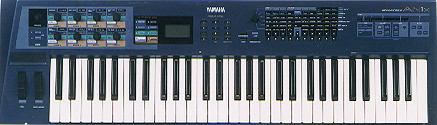
The AN1x is a fine synth, capable of emulating a vast range of analog sounds, and also capable of a large range of sounds that go far beyond analogue. The sound architecture is complex and versatile, far more so than many of the presets would lead you to believe. Many of the presets are very mainstream-dance oriented, so I erased many of them and created new sounds from scratch. When you initialize a voice on an AN1x, you can choose a variety of basic sound tamplates to work from, or you can create your sound from a buzzing tone. I've created realistic emulations of gongs, water drips/trickles, organ tones, bass drums that morph into record scratches (with backspins available via ribbon cortroller), all from scratch.
That is another thing that sets the AN1x aside from the flock of other analog modelers. The sound architecture is fully programmable. That means that you are not limited to making changes to presets, like you are on a nord lead2 or JP-8000. Because the sound architecture is fully programmable, you can go into any sound and make it into any other sound by turning knobs. The morph mode allows you to traverse the entire range between two sounds in realtime using a controller like the mod wheel.
The bass on this keyboard really rocks. It produces dirty basses, squelchy basses, bass drums... if you are persistent enough to create them. The on board EQ is a parametric, which is an advantage. You can boost frequencies as low as 34 hertz, which is quite useful for subsonics.
As a controller for other synthesizers, the AN1x is ideal. Not only can any controller control any internal parameter, but knobs and such can be routed to any control change message you want. I used this feature to control the breath control(CC 2) on my DX100 with the AN1x ribbon controller via midi. The arpeggiator is excellent and can synced with a sequencer or drum machine.
As an experimental synth the AN1X really shines. Those of us who lust for modular synthesizers are greeted by a variety of routing functions that allow the AN1x to use the output of one module to control another. For example, you can set the Frequency Modulation amount to be controlled by the FEG and the LF01, or controlled by the PEG and LFO2, or many other combinations. Sync and oscillator pitch can be similarly controlled.
The first LFO has 21 wave types. The second LFO is set to one type(triangle). Those who still desire more modulation control can turn to the Free EG, which allows you to record parameter changes and sync them to an external MIDI clock.
What can I say? analogs still have a place in my heart, but at under a grand, the AN1x is the most badass sound source around.
As for the complaints about the LOF not being syncable, there is an LFO reset switch which allows you to make the LFO start over when a new note is sounded. Adjust the LFO so that it keeps time and you're in business.
|