|
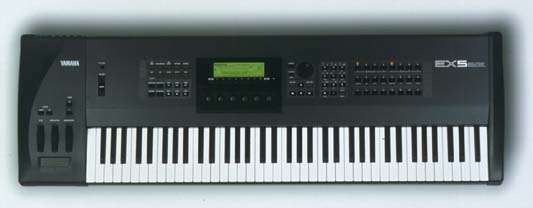
I'm using 1.0D OS - 1.13 TG (the last one). It seems that there is a 1.0E OS coming up, but with minor improvements. The 1.0D OS solves all the big drawbacks of the EX5 apart from low SCSI transfer. The presets are really good in a first overview; it's loaded with cool pianos-electric pianos and organs; you will also hear some of the best VL patches ever programmed. Pads are state-of-the-art, and pay special attention to the wild AN synthesis and the new FDSP processing -no other synth has it-. Anyway, amazingly, a lot of ROM waves are unused, so the full power of AWM synthesis remain hidden in this machine. Editing patches is very comfortable for me using the big screen, numeric keyboard and knobs. The manual is big & good. I rate it with a 8 because of the extreme depth of this machine; you could get lost looking for what you want. But believe me, it's there. Poliphony is 128; enough for any purpose. MIDI timing problems have been solved with the latest OS. You will only experience some timing issues with really hard sequencing, but there are workarounds to avoid them. Built it FX are really excellent; you can use 4 at a time in a performance with AWM synthesis or 1 at a time if you use AN-VL-FDSP parts. Now pay attention to the famous DSP power issue; some people will tell you that this is an underpowered machine (you'll get "DSP full" messages if you try to use, for example, several AN voices in a performance), but that's not true: simply, you have to learn the way it works and how to get the most of it. Is the Minimoog an underpowered machine because it's monophonic? See all the things that the EX5 can do for you as it is and not what it could do with a bigger DSP. What did you expect, 16 AN parts with 128 poliphony...? These are the real numbers: You get an amazing 128 voice AWM synthesis engine with 4 insert FX, arpeggiators, etc... and more: you can add the fine AN synthesis (up to 2 voices), VL synthesis (1 voice, well... VL is monophonic anyway) and the new and powerful FDSP processing (uo to 8 voices). Simply, you can't use more than 1 "DSP part" (AN-VL-FDSP types) at the same time in a performance. So, combine them with intelligence and remember that no other machine can do all this. Even using only the AWM synthesis, the EX5R beats all the JV-XV saga in terms of features, so consider the extra synthesis as it is: EXTRA synthesis. Expansion capabilities are: SCSI port, Flash RAM, Individual outputs, Digital output and conventional RAM. Ok, there are not sound expansion cards, but who needs them? Get the Flash RAM and build your own "expansion cards". Up to 16 Mb can be loaded in this type of RAM, doubling the internal ROM capacity. The EX5R is unusable as a sampler because of the obscene SCSI speed (more than 30 min. to load 65 Mb). So BUY the flash ram to get all the best of this unit. Consider this machine as a monster synth with sequencer and arpeggiators, not as a sampler. The internal sequencer is nice: 16 tracks, up to 30.000 events, a lot of functions, including quantization in real time. Enough for a complete arrangement -ok, it can not load several songs at the same time, but it can read & play directly from a diskette or ZIP, so this "drawback" is not a problem-. The only important thing on a music machine, the sounds... well, the EX5R is a high quality instrument that covers all the music styles, specially if you have the flash ram to load your favourite sounds. I can't express it with words, but it sounds amazing in all genres and in all types of instruments and sounds. Excellent top end, deep basses, clarity and quality.... Try it and hear by yourself. If it were lost I will replace it with another EX5R, for sure! The only question to remember: don't buy it as a sampler. This is the best all-round synth ever built
|