|
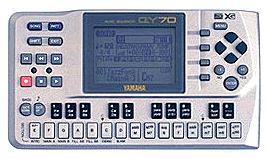
The QY70 is an ideal portable sketchpad (similar to the Roland PMA5), and is also a great way to record sequences without having to fire up a computer and set things up. The interface is fairly easy to use, and the manual (available from Yamahasynth.com for those who get theirs secondhand) is also well laid out.
I used this instead of a computer editor for years, combined with a Yamaha MJC8 to split the MIDI for different chains (to avoid delays from having long chains). I used it much with a Yamaha GC10 MIDI guitar and with a Yamaha WX7 wind controller. With the constant streams of CC's from both controllers, I usually only got three songs total into memory, but loaded more once I stripped down the total CC's in a song with the QY70's onboard functions to something more manageable, fitting 5 songs total.
The total number of onboard tracks is where the QY70 gave it a clear advantage over the PMA5, at least in my case, as the PMA5 didn't have enough tracks to record the guitar parts as 6 individual tracks, let alone adding even 1 wind controller track.
This unit was released a bit after the Roland PMA5, the other great handheld sequencer/sketchpad, and both have their strengths and weaknesses. Both have intelligent arrangers. The Roland has better patterns, IMO, and the instruments sound better (I believe they are the same as the SC55). I found that both the QY70 and the PMA5 had similar battery life. From here, though, a straight comparison of the specs will show the advantages of the QY70.
Total sequencer tracks: <br> PMA5, 8 (4 melody, 4 backing); QY70, 24 (16 melody, 8 backing)<br> Sequencer note/event memory:<br> PMA5 - 22,000; QY70 - 32,000<br> Preset patterns:<br> PMA5 - 600; QY-70 - 768<br> Onboard tone polyphony:<br> PMA5 - 28; QY70 - 32<br>
This is not necessarily a great live sequencer, not because of any problems in the unit itself, but because of the desire of some to be able to chain things live, or to loop certain parts on demand. However, it is great for basic sequencing, not merely for use as a notepad.
++++
Although the onboard sounds can all be tweaked through menus, they can also be changed easily in real time by devices such as the Keyfax Phat-Boy, which really changed my view of the onboard sounds' usability. It provides an analog paradigm with knobs for ADSR, filter cutoff and resonance, and LFO control. Devices such as these make it extremely usable as a better sound module, IMO.
++++
As I don't use the onboard sounds as much when using it as a sequencer, I haven't run often run into the problem about which others complain, that of a slight hesitation when changing patterns. However, having experimented with it, I know that it arises from the changing of voices when going from one pattern to another, as the sequencer sends a change message and the tone generator then resets the voices to the new pattern. (Most synthesizers experience a delay when changing from one patch to another, and the delay is typically lengthier when things like effects and such also change.) This can happen even if one is in the same pattern but resends the pattern name. **If staying in one pattern, one can remove the "change pattern" message from the sequencer, and avoid the change and subsequent delay.** If using outboard sound modules (as I typically do) the issue never arises.
|