|
First of all, it is futile to expect that we have the technology to duplicate the sound of an actual piano, especially close up. The entire instrument is a complex three-dimensional structure that cannot be done justice with a pair of stereo speakers, no matter how good the samples are.
Second of all, the technology does not exist in the form of memory capacity to sample all keys of a piano at all modes and weights of attack, including the three foot pedals that are not really just on/off switches.
That said, we are left with settling for a compromise in one way or another. My desire would be to own a brand new, 9-foot Steinway. But that would cost $80,000, a price I doubt that I would be willing to pay even if I had that much money, which I don't.
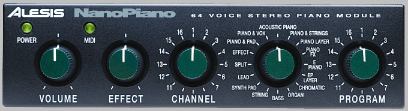
I ended up purchasing the Alesis NanoPiano. Having listened to the two demo tracks I found at http://kurzweil-europe.de/demo/sd_kmp1.htm, I would judge the Kurzweil Micropiano to be the better instrument, at a street price of $100 more. The Yamaha box spoken of by other posts under this heading now appears to be no longer available, so I abandoned my search for it.
The Alesis NanoPiano is made for stereo, and does not sound good in mono. The stereo image is exaggerated, so will appeal more to those who are more interested in hearing a rich stereo image than those who are interested in something that sounds more natural. Consequently, I find the NanoPiano to sound more natural at some distance from the speakers, such as when someone else is sitting in front of the keyboard and speakers playing it and I am somewhere else in the same room.
Not only does the NanoPiano does not retain any settings upon power-down, but it doesn't look at the position of the "effects" knob upon power up or upon a bank or program change. When you power it up or change the bank or program, it assumes that the "effects" knob is at the 12:00 position. It only "reads" the knob when you go to change it. This is a real nuisance. Unless the 12:00 position is where you already have the knob set, you have to go wiggle the knob to get it to respond to where you have it set. It took me quite a while to figure this out.
Another thing that I have noticed is that if while holding the sustain pedal down you play the same key on the keyboard twice, it will cancel the first envelope in progress and substitute the second. So for example, if you play a note once loudly, you can actually mute down that note by hitting it again very softly. This goes against the simple physics of the hammers striking a real piano string twice. Obviously, the NanoPiano is not smart enough to deal with that.
The NanoPiano has many other non-acoustic piano and non-piano patches, which are at the caliber of a late-1980s synthesizer (not trashy, but not state-of-the-art, either.)
Aside from the above criticisms, I am reasonably satisfied with the NanoPiano, and feel that it is worth the $300 that I paid for it.
|