|
My story regarding the DX7 turned out to be a rather interesting one. I first realised that there was something special about FM synthesis when I found out about plugging an old PSS series keyboard into a big amp back in 1997. The keyboard was tiny but the sound, specially for bass, well it was huge!
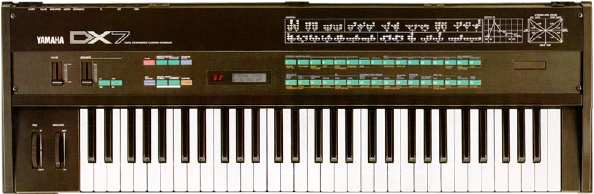
Then I found out about the DX7. It looked cool and as far as appearances go, it was my dream synth. It was also FM synthesis which is renowned for being exceptionally good at bass sounds. At that time I wanted good bass sounds and a cool looking synth. The DX7 fit the bill.
I found one for sale the following year for £300 in the local area and went to have a look at it, and my, was I bitterly disappointed. It was in a sorry state and to my surprise it sounded no better than the old PSS. I decided to lay the DX7 to the ground and forgot about it. They were out - no chance...
That was, until May 2001 when another one turned up for sale completely by accident. Over the years I had thought about the DX7 and kinda wished I'd had it. It was just in such a bad state that the £300 seemed wasted. When the second one came up, I found out that it was the original DX7 again and decided to give it a second chance.
On my first encounter with the DX7 I can only conclude that the owner had overwritten all the original sounds with his own - of which they all sounded, to be polite, rubbish. On the second try I recognised the sounds straight away from all my favourite 80s records. I think it was set to patch 15 on the default A group (Bass 1), which was used in loads of those records. I found the EP sound on location 11 and it sounded fantastic. Even the acoustic piano on button 8 sounded pretty good in the lower registers compared to some of the newer, sampled based things.
The physical condition of the synth was very good for it's age and I instantly fell in love with it. For £295, it was mine, and I have continued to be amazed by its ability to make almost any sound. Well, that is apart from analog pads and stuff, but this is just missing the point. The DX7 excels at almost everything else once a reverb or chorus is added to the signal.
Having said that, I felt that for lead sounds, once the portamento function was activated, the DX7 started to sound more analog than any of my other equipment, despite being totally digital. Organs, basses, electric pianos, strange, otherworldly noises and even deep string pads sound second to none on the DX7. For solo sounds, the DX7 is the synth I use. It never fails to amaze and always cuts through the mix. Here's another thing too - the DX7 is pure synthesis - no pre-recorded samples. This means that all sounds on the 7 have a life and animation of their own. As the sound of the six operators interact with each other, the sound is never static like sample loops. This is why I find piano sounds on this synth very pleasing to listen to.
Programming? Well OK there's no knobs or anything, the display is tiny and isn't backlit or anything (no replacement bulbs needed here then!), but it displays what it needs to as far as I am concerned. The key to unlocking the DX7 is to work out simply through experimentation what each of the parameters does and then use that knowledge to make a new program. I have programmed more custom sounds on the DX7 than any of my other synths which claim to be easier to edit than the DX7.
So, why does everyone gripe about the membrane control panel? I think it's cool because it's easy to keep clean (has anyone out there tried using car dashboard polish on it to cover the scratches? You will be amazed!) and really gives the synth it's look for being a completely flat control surface like no other synth. As far as I can tell, the membrane simply covers over normal buttons anyway - there is a nice, satisfying click when you push a button so it's OK with me.
The DX7 - it looks cool, it sounds cool. The EP must have been emulated on every single synth built ever since, but there is nothing quite like standing behing and playing the most famous synthesizer ever. Even all these years later there is still something about it. Maybe it's the looks, maybe it's the amazing history it has, maybe its the expensive, fluid movement of the keyboard itself. I don't know, but the DX7 truly is a special synth. The purchase I made will never be regretted. As the story stands, ever since 1998, the DX7 was always meant to be mine, even though my initial thoughts of it were completely the opposite to now.
No it can't do analog but so what, it can do everything else so I give it top marks. Five outta Five from me!
|