|
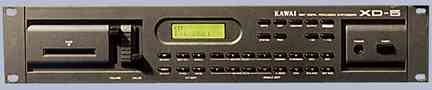
I really wanted to like the Kawai XD-5, I really did, especially when I realised that I was never going to sell it for as much as I paid for it, but it just wasn't working out. I mean, it was ALL RIGHT and it made some nice sounds, but it was a bother to programme and it never sounded as good as "stuff on records". You might think I'm asking the impossible, but, funnily enough, Yamaha RM50, the very same drum synth that Philip Pilgrim claims has "terrible and lifeless" sounds gave me studio-quality drums in the privacy of my bedroom studio and in the end helped me to decide to get rid of the XD-5 anyway.
During the year and a half I spent with it, I learned about its good and bad sides. There are plenty of both but I did feel that the bad ones decisively outweigh the good ones. I liked its versatility - drum modules of such complexity are very rare and anyone who wants to have unique drums in their songs should check it out, especially if you find one for $109, as The Sawblade apparently did. You get up to four samples per patch, two envelope-controlled filters with resonance, a ring modulator, a LFO, and a DCA.
I also liked the internal samples. There are 256 -30 or so cyclic, or looped synth waveforms, while one half of the rest are one-shot drum and percussion samples. The other half are the same samples, just reversed; it would be nice if the processor could take care of this so that more unique samples could be fitted into ROM. The cyclic waveforms are great: they can be layered with drum samples or used on their own - in the event of an emergency you can turn the XD-5 into a multitimbral, 16-voice polyphonic digital synth.
Six individual outputs were another great thing, though I didn't take as much advantage of them as I could've done, and that's because (this marks the beginning of the "bad sides") I found it nearly impossible to programme an "output patch". An output patch tells the XD-5 to which indiviual outputs certain sounds are to be sent, and it is a nightmare to set it up properly even with the manual right next to you. I don't want to turn this review into a panegyric to the RM50, but it's a fact that not only this particular feature but the entire OS is much more transparent and easier to get around. While patch and kit programming on the XD-5 are not as cryptic, they are awkward. The most irritating thing is that whenever you're editing a patch, the patch will respond to any MIDI note number, as if it were a pitched voice. This means that you can't have the sequencer playing your song while you're making adjustments - to see how the edit works in the context of the song, you have to exit the edit mode and switch from single mode to kit mode.
This probably wouldn't bother me as much as it did if the XD-5 would constantly delight me with fantastic drum sounds - but it didn't, really. I'm a fan of the "big" drum sound - heavy kicks, explosive gated snares, bent toms, and the like. What XD-5 delivered most of the time were clear, delicate drum sounds which I liked, sort of, but found no use for in my songs (feel free to contact me at sartre@siol.net to hear them).
I was very happy to find that the Yamaha RM50, the only similar drum synth, as far as I'm aware, solved all these problems for me. I love the sound, programming is a breeze and its MIDI implementation is fantastic. If you're in the market for a drum synth, try to check out both the XD-5 and the RM50. You may find yourself vastly preferring one over the other, as I do, or like them both; they're different enough that they could well complement each other. With both machines selling for less than $200, you could buy yourself a lot of drum programming power for less than most new sample-playback drum machines would cost you - and there's just NO comparison.
|