|
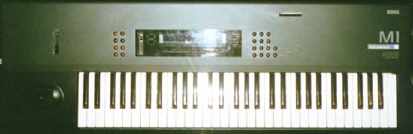
Been gigging with the M1 for 12 years. It became a good friend after I tossed the factory patches (they're mainly sales demos of some of the cool things the board can do) and started programming layers and splits to wrestle the machine into being an instrument.
From there, started making basic programs, stacking them up into combinations. The M1 will really perform if you treat it like a synth instead of a preset box.
My advice to players who stumble into one of these for cheap is too first make sure that you can find the factory orchestra card, and some of the other cards for it. Major useful sounds (killer strings/good piano on the orchestra card) are on those cards, and in the third party patches for it.
Use those as your tutorial, and make your own programs, combinations, splits, layers. Then you'll have some real soundpower that you KNOW how to use, in a dependable, rugged keyboard.
Traded in an O1/W and one of my M1s for the Triton, and love the fact that every quirk that annoyed me about the M1 is fixed on the Triton. But the Triton has the same prob as the factory M1; the preset patches are for demoing the instrument. There's a ton of useful sound there too, but I know that once I get a few hundred original programs and combinations written in, it should be spectacularly useful. Like a mini-synclavier in a 30lb. keyboard. Amazing!
And here's the best part; when you move up the programming chain to the Triton, you don't have to re-learn a completely new interface.
Not just good software design. The M1 is the Triton's great-grandpa.
|