|
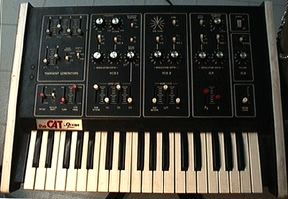
I have the first version with the discrete filters and VCOs.
This sounds very little like an Odyssey, in fact sounds very like a grittied up Minimoog (Ok, Gritty compared to the two RA.Moog examples I`ve owned anyway), using one of the Sub-Oscs as a third VCO you can immitate almost all of Rick Wakeman`s classic Mini lead sounds, just remember to be careful with the waveform level sliders and even more careful when playing with the resonance control, that filter gets very squelchy on the verge of self Osc but 1MM of slider travel can kiss your tweeters goodbye..
Comparing finctionality with an Odyssey certainly kills all thoughts of it being a clone with gains and losses everywhere - No pink noise, no coarse tuning for VCO2 (the fine one does over an octave however), no PWM on VCO2, no S&H mixer, no "vibrato" PPC pad of the Mk3 Odys and far less mod destinations.. BUT gains in far better X-Mod, better sounding Sync, knobs instead of sliders for pitch (way better that is) LFO Delay (on SRM models), Waveform mixing (as on the Axxe but NOT the Odyssey), 2-Sub OSCillators, one for each VCO and a way to switch to MONO mode, the Ody is stuck in Duophonic always.
I KNOW that people get tired of seeing synths get a "5" but it`s a damn good halfway house between two bits of gear which would total £1600UK for the Pair - and the cat only costs about £450UK..
For the record, the SRM models had firstly the SSM2040 (REV-1 Prophet5) filter, then later the SSM2044 (Polysix) filter but retained the discrete VCOs .. SRM-II had Curtis 3340 VCOs and SSM 2044 filters and a digitally scanned keyboard.
I Personally prefer the all discrete original for it`s wildness and the first SSM2040 equipped SRM for it`s smoothness (though HOPE that the filter chip doesn`t go!!! - I wasn`t as impressed with the 2044 based later models but they are still damn good machines..
|