|
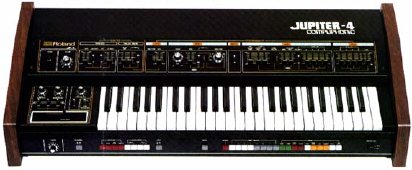
How could you not love the Jupiter 4? It has morew personality than any synth I've ever played, including modular Moogs and whatnot. That's not to say it's BETTER than a Moog - it's certainly not - but it's ENDEARING. I call mine 'Christine' because she reminds me of the old car in the Stephen King book that is possessed.
The J4 weighs a ton, is all metal and wood (except for the knobs and sliders and switches, of which there are over 40); mine doesn't like being woken up suddenly, and you might as well go make a coffee while she gets herself in tune. She has buttons for presets and user patches under the KB, which is also where the arpeggiator and various other buttons live. CAUTION - if you play this synth standing up, you will bump them with your legs, and suddenly find yourself playing a 'trombone' in the middle of a filtered swept arp pattern. The plus side of this is that there is a vast flat area on the top of the thing on which you can sit your dinner and about 10 cans of beer. Clearly this would not have been a sensible place to put the buttons, because it would mess up the aesthetic proprotions of that big black area of tin with "jupiter 4 - compuphonic" written on it in groovy 70's space-age font. I mean, how could you not want a synth that has <a href=http://www.southcom.com.au/~fluke/j48.jpg> this </a> on it?
(Sorry if that link doesn't work. Don't know if you can put HTML in these reviews)
Ok, sensibly... This is a very early poly analog synth - and I mean, it's 100% analog; no Curtis chips or DCO's or anything silly like that. It can sound warm, bright, cold, and IMO very cool indeed, even if it doesn't have the real buzzsaw quality that you could get out of some synths of the era. It's strengths are undoubtedly it's arpeggiator - it just sounds beautiful - and it's amazing LFO. Get a nice pattern going, get the LFO blaring away in overdrive, add the 'hold' function, some portamento, and it can sound like all hell's broken loose. It also has a nice 3 position sub-oscillator, and an octave down switch which together can give it some pretty deep bottom end.
It has a few drawbacks (other than weighing about 40 pounds). The arpeggiator could do with some range control (it has up, down, up/down, and random, but it will just play the length of the KB - or at least the length of the KB above the lowest note you use), and the user patches can't be tweaked once you've stored them - so you'll probably find yourself using patch-sheets if you want to fiddle with your sounds while playing live (now THAT's retro!). However it's a loveable monster of a thing, and the arpeggiator can just sound beautiful. As soon as I got mine, my usual synth went into semoi-retirement while I played with the Jupiter. I don't know if it's a classic or not. I don't care. I like it.
|