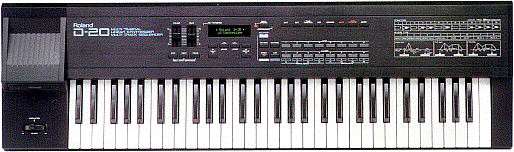
|
Well, I bought it in '87 new, because I couldn't afford a D-50 or an M-1 (wish I had bought the M-1 instead...) so I spent the next 5 years convincing myself that it sounded better than it did.. It was OK in a band situation, though. I think it would have been a fantastic keyboard had it come out in, say, '85, instead of '87 (after the *D-50*)...the factory patches were all very weak and thin, and brittle. There was nothing smooth about the D-20. As I got into the instrument more, some of the best sounds were made by making huge layers...that helped at the expense of polyphony.. The programming...? More complicated than it needed to be...you know, when you have to push 7 buttons 15 times repeatedly to get to the TVA level for the 4th partial...or whatever. But, you get used to it..
Lets see...stripped down LA synth. 32 voices (partials), up to 2 partials per program, and 2 programs for a "patch" ("play mode"..in performance mode, you only got the basic 2 voice patches..)Jeez...three layers of sound building...crazy. The voice was a simplified D-50 set-up..either a "synth" or a "sample" partial, (the "synth had a filter in the loop, the "sample did not.."
Similar to the D-50, the D-20 used structures to determine the type of oscillators the "pairs of paritals" used...it also threw in some ring-mod type structures..not good for much as i remember..
Other than that...one vanilla LFO per voice, simple filter, simple rate/level envelopes... Crappy reverb and tap delay FX, they didn't help much.
It had that goofy 8 track sequencer....very limited. Frustrating. Many times I used a 4-track and live recorded overdubs, rather than mess with the D-20's sequencer... Years later, I did find a good use for the seq...I did long, "ambient" looping 8 track pieces of sound FX, such as "night-time" bug sounds, "startrek-bridge" sounds, etc...very nice and convincing, although I'm sure Roland didn't have that in mind...LOL
Nothing was terribly realistic, unless you were trying to model the sound of "a thin, brittle, stripped down digital synth". In that case it did very well. it works well for music "played by a musician who couldn't afford an M-1".... The onboard FX are slightly better than the old spring reverb in peavey amps... The D-20 had attack velocity, and nothing else...
*you could do some nice sounds if you carefully composed and layered huge mutli-patch stacks together..ofcourse at the expense of polyphony..
About the 3rd year I owned it, many of the panel buttons stopped working...also some of the keys lost tension and became "physically" and "sonically" unstable (wrong velo triggers, etc..) The cost to repair was not very cheap, if I remember correctly...
It was a price point, something Roland rushed into market to get people "into the stores"...lets just say, many Roland Engineers probably won't put the D-20 on their resume'.
|