|
I've got mine a few days ago with an extra ROM card for the equivalent of 70 $, and sure, I love it. I've bought it since the other user reviews told that it would be, simply-spoken, a TX81Z with a built-in sequencer. This is, as you'll see, not quite true, although I don't own a TX81Z myself to compare with. It's rather the table-top version of a YS200. As it is patch-compatible with the TX81Z, I recommend reading the TX81Z user's reviews for further information on sound character and programming and try to point out the differences between the two units.
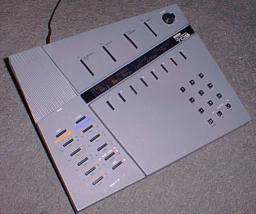
The TQ-5 is a 11"x 8 2/3" strangely but cool designed table-top unit with a 2x40 character display with 8 display-associated buttons, a numeric block for quick parameter changes and additional knobs for editing and the sequencing functions. There are two outputs and a headphone jack. It has a built in clock and shows brightly time and date, if you don't edit it for some minutes, which is a very funny feature. There is a card slot, which can hold whether ROM cards with preset sounds (100 patches or two banks of 100 patches) as well as RAM Cards to store user patches and sequencer data. There are 100 preset patches and 100 user patches slots.
The TQ-5 is easy to program, almost self-explaining, which is due to the limited editing features from the unit itself. Obviously, it was made for users who prefer just to tweak a few presets rather than dive into the widths of FM synthesis. You can control a few tone and amp envelope parameters of every patch, but you've got no control of the single operator (which shares the waveforms and algorithms of the TX81Z). There are a few global tone controls like brilliance, waveform and the possibility to select a four-number code for the different operators' waveforms, which can alter the sound dramatically with just a few button hits. There is a LFO section, which lets you adjust speed, vibrato and tremolo parameters and a control menu to set the destination for velocity, breath controller parameters and aftertouch. The FX section contains 10 effect types (the TX81Z hasn't got), including reverb (gated rev also), delay and distortion FX, which sound cheap but give the sound a certain lo-fi touch which can be useful.
Since the editing from the unit itself is rather limited, you certainly get more out of the unit if you program it via a computer-based patch editor. This lets you also load other 4OP module's patches (incl. DX11/21, TX81Z, YS100/200). Using the editor (I've used Blue Bear's Shareware Editor) will reveal some of the biggest shortcomings of the TQ-5 compared to the TX81Z, namely the lack of the TX's microtuning features and the lack of portamento (!!!) :(, but gives you full control over the operators envelopes, FM algorithms, LFO waveforms, and modulation settings. Blue Bears Editor features a so called "Tone Zone" field to try out a patch before dumping it to the TQ-5, which is a very useful feature and avoids dumping after every editing step to check the effect on the sound while programming. I really like the unit's sound (the nice well-known 4-OP-FM bass sounds, expressive lead sounds and crazy FX sounds - you guess it), its outputs are not very noisy and you'll be able to use the huge patch library of the other Yamaha's 4 OP synths. First generation 4OP-FM-synths (like the DX100) are reported to sound rougher and noisier because of other (lower bit) D/A-converters used - so this should be more 'hi-fi' but less noisier too.
A special TQ-5 feature is the integrated 8-track sequencer. Its functionality may be limited in comparison to other hardware (and of course software) sequencers, but step-editing is possible as well as syncing external machines (like drumboxes) to it or to control external MIDI Modules - maybe useful in a low-budget minimal setup for electro or minimal house with a drum machine and another monophonic synth. As the TQ-5 is 8-part multitimbral, you should be able to create simple playbacks. You just have to define how many voices you like to allocate to each of the 8 parts. There are also several settings to split or layer parts played by an external keyboard or sequencer.
Don't get me wrong, when the review sounded a bit negative so far - I really love this unit !- it's a real steal at the current prices, you'll get a huge library on the web for it, it sounds good, it's easy to program and the sequencer is a nice extra in a hardware-based setup. So you should give this cool and cheap piece of gear a try. But I was a bit disappointed, when I discovered that some of the nice features of the (older) TX81Z haven't been integrated (portamento, microtuning) and the instruments' user-friendly design can't be used to program FM patches from scratch which would make it a real killer device. Sorry for this long statement, I tried to provide the info I hadn't when I bought it.
|