|
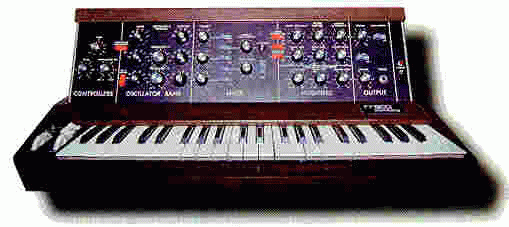
The minimoog is not an all-in-one synth. It is a monosynth. For being the first synth made for musicians, it is suprisingly versatile, though. I think critics of the minimoog simply prefer newer synths, pre or post midi, that give them more tuning stability, more smooth sound, etc.
But there are a few things this synth still excels at even to this day, and for this reason it will always be a value. 1) the Moog Ladder Filter. This shapes the sound and creates a richness that is till being emulated to this day. 2) The fast attack envelope. This assists the filter and you can get a click sharp attack effective for danceable bass lines and sharp lead lines. 3)3 independent oscillators. Each oscillator may be tuned in its own range, you have a huge range you can have with them playing together or separately. Plus these and the noise/external input section may be mixed to whatever level you want them at. 4)The 3rd Oscillator may be controlled by or function independantly of the keyboard, is capable of sub sonic LFO frequencies and can control the filter amount or the other 2 oscillators. This gives you a wider variety of sound possibilities than other synths with a dedicated LFO that can't go into audible frequencies. 5)Lastly, everything is accessible with nice big round knobs for tweaking!
Even if this synth hadn't been the first one to come out and therefore the one that all the others were emulating and using as a benchmark for analog subtractive synthesis, the minimoog would have been a classic synth to own. Easy interface, tweakability, great bass lines, and great lead lines. Plus you can make lots of weird sounds with them as well. Whether or not you don't like any of the limitations you have to admit this is the best simple non-modular monophonic synth available.
|