|
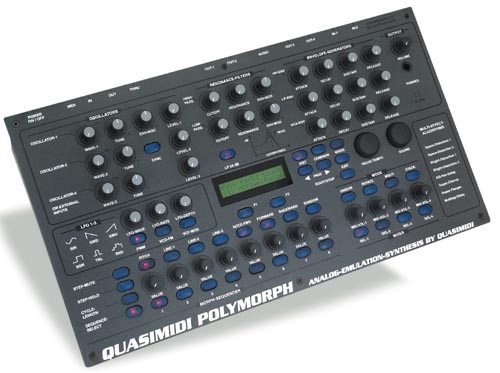
I like it, but it's got enough shortcomings to keep me from loving it. Keep in mind that I don't have a manual, so these problems may have solutions that I've overlooked.
Here's what pisses me off.
1. Stepping parameter modulation. Ugh. I hate this. Most knobs send and receive a MIDI signal, but they zip badly. The up side is that they smooth out nicely when being controlled by LFO--usually. See #2.
2. Sampled osc sync and PWM waves. When you press the sync button and modulate the pitch of osc 1, you're actually cycling through sampled sync waveforms of a saw wave. Even if you started with a sine wave, it's suddenly a synced saw wave when you press the sync button. That leaves you with only one sync sound, which is a shame, as I would love to be able to sync and mess with all the cool oscilator waveforms in this thing.
Same deal with the PWM. Half of the waveforms available in osc 1 are snapshots of the various stages in a PWM sweep. When you set the LFO to control the PWM, all it does is cycle through these waveforms. Osc sync and PWM parameters therefore are extremely unversatile and they unconditionally step between values.
3. Bad portamento. The portamento is "steppy" too. It's not so noticable if you have it set slow, but as you increase its speed, it really tumbles between notes. When it's set even higher, it compensates for its lack of smoothness by actually crossfading between notes!
4. Stupid retriggering notes. If you play the same pitch twice with a patch that has a long amp attack and release, it kills the tail of the first note as soon as the second note is triggered--usually. Some of the waveforms available in osc 2 and 3 don't do this, which is bizarre. This means that if you have osc 2 set to one of these allowing waveforms, and osc 3 set to a bad one, osc 2 will trail off nicely when the same note is struck again, while osc 3's tail gets run over. This requires smart note placement if you plan on using the polymorph for pads.
5. Hanging-over notes. Even with the amp release set to 0, the note duration is always slightly longer than the programmed note. This is especially noticable when you're running the poly's sequencer and one of the lines is controlling, say, cutoff. If you have step one programmed to play a note with a low cutoff, and step two is silent but the cutoff is high, you'll hear a quick spike of the cutoff at the very end of step one. I decided at first that this was a really cool effect, but it lost its appeal after all my sequencer parts started to sound that way. Yes, you can adjust the cutoff of silent steps to correspond with the previous step's cutoff, but what a pain.
6. No sequencer step-hold. There's no way to sustain a step longer than one step unless you want to take the time to assign one of the controller lines to the amp release... is there?
7. Weak modulation options. There's no mod matrix here, and you have the option of assigning velocity to volume and volume.
8. Aliasing of high notes. And aliasing of not-so-high notes. A whole slew of overtones get introduced to the signal if you play anything above like a C4.
9. Rhythmic delay will not do 3/16 timing. What's up with that?
With all that aside, I'll say it again that I like the Polymorph. The waveforms in osc 2 and 3 are truly cool, and the sequencer lets you twist the sound all over the place. The filter is one of the most unique I've heard and the effects and EQ can really make it scream. The things that make it unique are what it does best, but everything else seems to have been an afterthought.
|