|
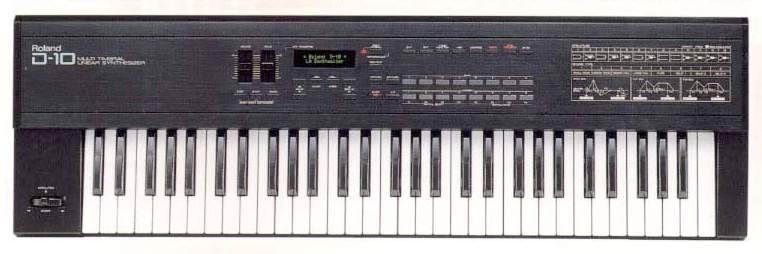
I just bought this keyboard a week ago for an absolute bargain price of 100 quid. For the money I paid, this is a pretty high spec synth.
What made the D series synths unique was that they combined traditional analogue synthesis with digital sampling. Seemingly the only way to make a sound more realistic was to sample it but memory back in the 80s was expensive so there was only room to sample the attack transients. The rest of the sound is handled with conventional subtractive analogue synthesis.
The best sounds are definitely without a doubt those rock organs. The rotary effect on a real organ is immitated perfectly on this synth, and sounds way better than the organs on my Korg 01w. Also, because you've got analogue waveforms, you can create pretty decent string pads too. Some of the pianos are okay-ish but the decays are too short and if you hold a chord down it's too obvious that the sound is a composite of two different types of sound rather than a coherent single one. The fretless basses are pretty nice and the slap bass samples are pretty good but too short so they would probably benefit from layering with another synth. Also, the animation and chorusin effects found in acoustic instruments that the Yamaha DX7 could emulate so well is much more difficult on the D-10 in the absence of the complex feedback loops and changes in timbre that the DX7 handled with ease. This means that while your attack side is more realistic because of the samples, the decay side is more static and lacks the realism and depth you could get on the DX7. Solution: layer the two together...
The construction is pretty good too - made from aluminium on the top and steel on the base, it weighs in at almost half the weight of the Yamaha DX7 at around eight kilos but is still reassuringly weighty and sturdy to play. My only gripe about the construction is that you can hear the sounds of the springs under the keys echoing around the keyboard if you tap them.
I still have yet to program the D-10 but definitely lie in a position, as a Yamaha DX7 owner, to say that the editing on the D-10 is even less obvious than the DX7. In edit mode on the D-10 you are not offered the luxury of knowing what the panel controls do - there's no labelling so the whole thing is very much a hit and hope affair indeed.
I think the best things about the D-10 are its string pads and synth bell/atmospheric type sounds, and the on-board drum programmer is also a great feature catering for self indulgent bedroom jamming without having to worry that you're using a cheap home keyboard. The D-10 proudly displays the word 'synthesizer' on its front panel, and rightfully so!
|