|
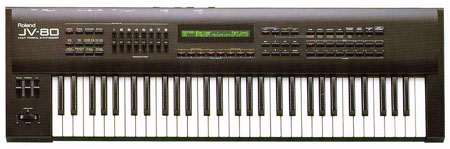
I got one of these second-hand back in '04 as I wished to get a second keyboard for live playing that wouldn't break the bank, and a friend of mine was selling one of these. It was in mint condition, and had the Pop expansion board in it.
Overall impression: a good stand-alone unit for live playing.
The piano sound isn't wonderful, but it does the job. I sometimes use it when my other keyboard is being used for other sounds. (My other keyboard is an A-80, and my usual piano sound is a U-110.) For example, I might have a specific sound or sounds I need from the A-80's set-up, but I might need a bit of piano as well, so the JV piano sound gets used. I use the piano on the expansion board - it was the only half-pie decent one. 60's Electric Piano on the expansion board is great! I use it as standard for electric piano, unless the Wurlitzer sound is specifically required, in which case I use a Korg X5DR. The JV is good for Analogue emulations, too. Last year I did a show which required a lot of analogue sounds, and it was a good thing I had the JV, as it was head-and-shoulders above anything else i own for those. It is the only unit I owned at the time that had Portamento, too, which is a definite plus.
Minuses. 1) The CRAZY Midi implementation. Do you know that if you send the JV-80 a note from an external source, and hit the JV's pitch bend lever, the note will ignore it completely. Similarly, if you hit a note on the JV's keyboard, and send it volume change messages from an external MIDI source, it will ignore them completely. At the time that I bought it, I was working in a sequenced two-piece set-up, and this MIDI implementation defeated half the purpose of getting it; as I was unable to automatically set it up via messages from the sequencer the way I did with all my other gear - the JV ignored any such messages completely. I also was unable to use the A-80's Damper pedal (controller #64) to control the JV, to cut down on the number of pedals under my feet - that was annoying.
Don't get me wrong, this unit functions very well as a stand-alone unit! But anyone considering using this unit in a MIDI set-up should bear this in mind.
2) Its output is relatively weak. You need a bit extra mixer headroom. For some weird reason, its output becomes even weaker when playing notes received from an external MIDI source.
3) 28-polyphony nowadays is a pretty low ceiling. I don't use mine in Performance mode, but if I did, there would be problems in the notes-cutting-off department. There sometimes is in Patch mode as well, if the patch concerned uses three or four partials, and the sustaining pedal is down.
4) The internal factory sounds are mostly average. I wouldn't consider getting one of these units without an expansion board. The one in mine basically MADE the synth. Getting the patches off the expansion board (as opposed to the sounds) is cumbersome, though. You can't access them directly off the expansion board, you have to save them to User or Card memories. That said, the patches that I use from the expansion board are pretty good.
5) The unit as I bought it is weak in Organs. I guess that would require another expansion board - but there is only room for one in this thing, and changing one around on stage is out of the question.
I would recommend this unit to someone on a budget, someone starting out wanting a reasonably serious keyboard, or someone whose requirements weren't too fussy who only wanted to use one keyboard - provided it had an expansion board in it. If you're thinking of getting one, make sure it has one, otherwise look elsewhere.
I would recommend avoiding this unit to anyone using a sequencer or other MIDI-dependent set-up.
|